

A New Eye on the Cosmos
NASA's latest flagship mission, the Nancy Grace Roman Space Telescope, has begun its journey to a stable orbit 1.5 million kilometers from Earth. Named after Nancy Grace Roman, NASA’s first chief of astronomy and the “Mother of Hubble,” this observatory
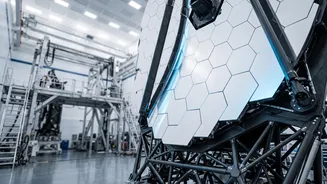
is poised to revolutionize our understanding of the universe. Unlike its famous predecessors, Roman is not designed to stare intently at single, tiny patches of sky. Instead, it is a survey instrument, built to scan enormous cosmic regions quickly. It shares the same mirror size as Hubble (2.4 meters) but is equipped with a camera that provides a field of view 100 to 200 times larger. This incredible breadth will allow it to create vast, high-resolution maps of the sky, gathering more data in its five-year primary mission than Hubble has in over three decades.
The Power of the Panoramic View
The key difference between Roman and other space telescopes is its perspective. If Hubble and Webb are like photographers using a powerful zoom lens to capture exquisite detail on a single tree, Roman is the photographer with a wide-angle lens capturing the entire forest. Its 300.8-megapixel Wide-Field Instrument will capture panoramic images with the same stunning resolution as Hubble, but on a scale never before possible from space. In a single pointing, Roman can capture an area of the sky larger than the full moon. This capability is essential for large-scale sky surveys, which are systematic efforts to map celestial objects and phenomena. By repeatedly observing huge swaths of the sky, Roman will build an unprecedented atlas of the cosmos, identifying new targets for Webb and other telescopes to investigate in greater detail.
Chasing Cosmic Phantoms
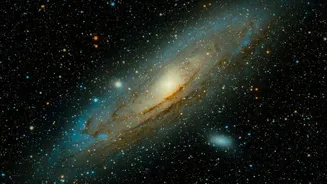
Roman has two primary scientific objectives: to understand the mysterious force known as dark energy and to conduct a comprehensive census of exoplanets. Dark energy is the name given to the phenomenon causing the universe's expansion to accelerate, but its nature remains one of the biggest puzzles in physics. Roman will tackle this by measuring the precise positions and distances of billions of galaxies and observing distant supernovae. It will also pioneer the use of a technique called gravitational microlensing on a massive scale. This method can detect planets by observing how their gravity bends the light of a more distant star, allowing Roman to find thousands of new worlds, including small, rocky planets and free-floating 'rogue' planets not orbiting any star. Additionally, a sophisticated Coronagraph Instrument will test technology to directly image large planets by blocking the overwhelming glare of their stars.
A Collaborative Cosmos
Roman is not working in isolation. It is part of a new generation of powerful survey instruments that will work in tandem to create a multi-dimensional map of the universe. Its closest partner is the ground-based Vera C. Rubin Observatory in Chile. While Roman provides crystal-clear infrared images from space, Rubin will scan the entire visible southern sky every few nights, creating a time-lapse movie of the cosmos. By combining their data, astronomers can achieve a more complete understanding of cosmic objects. For example, Roman’s sharp images can help deconstruct blurry objects in Rubin’s wider view, improving the accuracy of the ground-based survey. This collaborative approach, where one observatory identifies targets and another performs deep follow-up, represents the future of astronomical discovery.
The Road Ahead
Following its successful launch aboard a SpaceX Falcon Heavy, the Roman Space Telescope is currently in a commissioning phase, a period of about three months where engineers will test and calibrate its instruments. The spacecraft is on its way to the second Sun-Earth Lagrange point (L2), a gravitationally stable location where the James Webb Space Telescope also resides. Once it becomes fully operational, Roman is expected to generate enormous amounts of data—far more than any previous NASA astrophysics mission. The first public images are anticipated in early 2027, kicking off a new era of cosmic cartography. This mission, which was notably delivered ahead of schedule and on budget, promises to fill in the gaps in our cosmic photo album, revealing the grand structure of the universe in breathtaking detail.