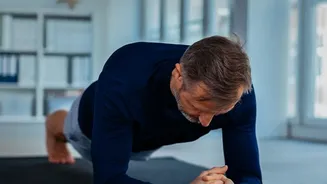




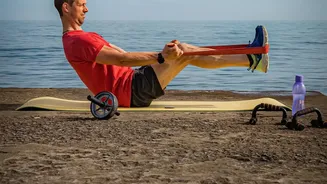


Your Torso Is Your Body's Anchor
Many people hear "core" and immediately think of six-pack abs. But your core, or torso, is a complex group of muscles that includes your abdominals, back muscles, hips, and even your glutes. Think of it as a muscular corset that wraps around your entire
midsection, stabilizing your spine and pelvis. Every movement you make, from bending to tie your shoes to lifting groceries or simply sitting upright, originates from or is supported by your core. When these muscles are weak or unbalanced, it can lead to poor posture, lower back pain, and a higher risk of injury because your body lacks a stable base to move from.
Prioritise Control Over Crunches
The key to unlocking the benefits of torso training isn't about doing hundreds of crunches or holding a plank until you shake uncontrollably. The real secret is focusing on technique and control. Slow, deliberate movements are far more effective for building deep muscular endurance and stability. When you rush, you often rely on momentum rather than muscle, which can lead to strain and doesn't effectively train the deep stabilizing muscles like the transverse abdominis. Engaging your core means actively drawing your navel toward your spine, creating tension as if bracing for a gentle push. This control is what protects your spine and translates into better stability in your everyday life.
Exercise 1: The Dead Bug
The Dead Bug is a fundamental exercise for developing core stability and coordination. Lie on your back with your arms extended toward the ceiling and your knees bent at a 90-degree angle directly over your hips. Press your lower back gently into the floor to engage your core. Slowly lower your right arm and left leg toward the floor simultaneously, moving only as far as you can without letting your lower back arch. The key is to keep your torso completely still. Return to the starting position with control and repeat on the other side. This movement targets the deep abdominal muscles that resist spinal extension, which is crucial for maintaining good posture.
Exercise 2: The Bird-Dog
The Bird-Dog is another excellent exercise for promoting stability across the entire torso. Start on all fours, with your hands directly under your shoulders and your knees under your hips. Keep your back flat, as if you could balance a tray on it. Engage your core, then slowly extend your right arm straight forward and your left leg straight back, keeping them both at hip height. Hold for a moment, focusing on preventing your hips from rotating or your back from sagging. Return to the starting position with control and repeat on the opposite side. This exercise challenges your balance and strengthens the muscles that support your spine.
Exercise 3: The Glute Bridge
Your glutes are a powerful part of your posterior chain and play a major role in core stability and posture. The glute bridge targets them directly. Lie on your back with your knees bent, feet flat on the floor about hip-width apart, and your arms at your sides. Tighten your abdominal and glute muscles, then press through your heels to lift your hips off the floor until your body forms a straight line from your shoulders to your knees. Squeeze your glutes at the top without over-arching your back. Hold for a couple of seconds before slowly lowering your hips back down. This strengthens the muscles that support your pelvis and can help alleviate pressure on the lower back.