





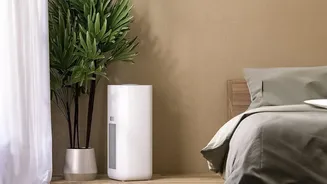
The promise is alluring: a few beautiful houseplants can scrub your home’s air clean. It’s an idea that has sprouted countless online guides. But while these leafy friends are lovely, their power as natural air purifiers is often overstated.
The Legend of the Air-Purifying Plant
The belief
that houseplants can cleanse our indoor environment largely stems from a 1989 NASA study. Facing the challenge of maintaining breathable air in sealed space stations, researchers tested common plants in small, airtight chambers. They introduced volatile organic compounds (VOCs) like formaldehyde and benzene and found that, yes, plants could absorb them. The problem? These lab conditions have little in common with a real home. A house or apartment has constant air exchange from open windows, doors, and ventilation systems, which dilutes pollutants far more effectively than a few potted plants. Subsequent research has shown that you would need a jungle-like density of plants—anywhere from 100 to 1,000 per square metre—to compete with simple ventilation.
1. The Snake Plant (Dracaena trifasciata)
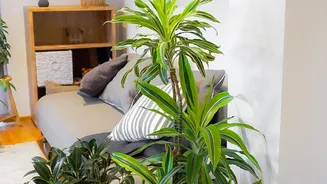
Often called Mother-in-Law's Tongue, the snake plant is a champion of minimalist chic and is famously hard to kill. It's frequently at the top of 'air-cleansing' lists, credited with removing toxins like formaldehyde and nitrogen oxides. It also performs a special type of photosynthesis that allows it to release oxygen at night, making it a popular choice for bedrooms. While these claims are based on truth, the effect in a normal room is negligible. A single snake plant's impact on air quality is so small it's virtually unmeasurable compared to the effect of opening a window.
2. The Spider Plant (Chlorophytum comosum)
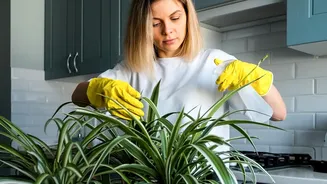
With its arching leaves and cascading 'spiderettes', the spider plant is a resilient and pet-friendly favourite. It is often praised for its ability to filter formaldehyde and carbon monoxide from the air. Like the other plants on this list, it did show these capabilities in NASA's sealed chambers. However, in a real-world living room, its air-purifying contribution is minimal. Its reputation is more a testament to its hardiness and ease of propagation than its power to significantly clean the air you breathe.
3. The Peace Lily (Spathiphyllum)
The elegant peace lily, with its glossy dark leaves and striking white flowers, is another staple of clean air guides. It is said to be effective at removing pollutants like ammonia, benzene, and formaldehyde. Some also note its ability to absorb airborne mould spores, making it a suggestion for bathrooms or damp areas. Again, the evidence for this comes from controlled lab settings. In a typical home, you'd need a forest of peace lilies to make a dent in pollutant levels. It's a beautiful plant, but not a substitute for an air purifier or good ventilation.
4. The Areca Palm (Dypsis lutescens)
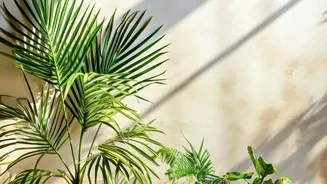
This lush, feathery palm brings a tropical vibe indoors and is praised for its ability to remove toxins like formaldehyde, xylene, and toluene. The Areca palm was even ranked as the top air-purifying plant in one assessment based on the NASA data. It also has a high transpiration rate, meaning it releases a fair amount of moisture into the air, which can help with humidity. But for removing chemical pollutants, the same limitation applies: its effect in a large, ventilated space is too small to be significant.
5. English Ivy (Hedera helix)
A classic trailing vine, English ivy is often recommended for its supposed ability to filter out a wide range of airborne pollutants, including those from cleaning products and furnishings. It performed well in NASA's chamber tests, showing it could remove several VOCs. While it's an attractive plant for a hanging basket or shelf, its air-cleaning powers in a real home are vastly overstated. To see a meaningful improvement, the number of plants required would be completely impractical for any normal living space.
6. The Boston Fern (Nephrolepis exaltata)
The lush and feathery Boston fern is another plant celebrated for its air-purifying prowess, particularly against formaldehyde and xylene. It's also known to be a great natural humidifier. While it can indeed absorb pollutants, the rate at which it does so is simply too slow to have a noticeable effect on the air quality of an entire room. Like the others, its reputation is built on lab studies that don't reflect real-world conditions.