









A Tale of Two Planets
Mars has a feature so vast it defines the entire planet: the crustal dichotomy. It's a stark difference between its northern and southern hemispheres. For as long as we’ve studied Mars, the south has been seen as the old guard—highlands, thick-crusted,
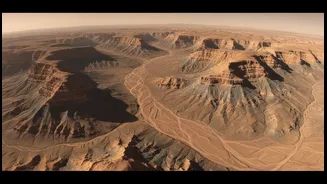
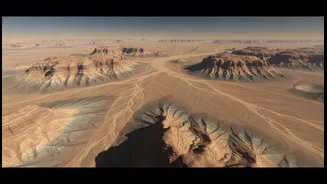
and covered in craters from billions of years of impacts. The northern hemisphere, by contrast, is a vast, smooth lowland, with a much thinner crust. The prevailing theory was that this area was once a massive, cold, and relatively static ocean basin, formed by either a colossal asteroid impact or ancient mantle processes. In this story, the southern highlands, with their evidence of volcanoes and ancient lakes, got most of the attention in the search for past life.
A More Dynamic North
Recent studies are now challenging this view, suggesting the northern lowlands were not just a passive basin but a region of significant geological activity. The key lies in that thinner crust. Scientists now propose that this thinner crust in the north would have allowed much more heat from the planet's interior to escape. This geological heat could have driven widespread hydrothermal activity on the ancient seafloor. Instead of a frigid, static ocean, this paints a picture of a dynamic environment where hot, mineral-rich water was actively bubbling up from below. Evidence for this comes from minerals like serpentine, talc, and carbonates detected by orbiters, which are often associated with hydrothermal systems on Earth. These findings add a new dimension to our understanding of the early Martian environment, suggesting it was far from uniform.
The Recipe for Habitability
Why is this so important? Because hydrothermal vents are considered one of the prime candidates for where life on Earth began. They create a perfect storm for habitability by providing two essential ingredients: a persistent energy source (heat) and a rich supply of chemical nutrients dissolved in the water. These environments are teeming with life on Earth's ocean floors today, completely independent of sunlight. Finding evidence of similar systems on ancient Mars is a game-changer. Recent discoveries from the Perseverance rover in Jezero Crater, located on the edge of the northern lowlands, have reinforced this idea. The rover identified silica-rich minerals, including quartz, which suggest formation in a hydrothermal system, possibly triggered by the impact that created the crater. This means Mars not only had liquid water but also may have had the energetic, chemical-rich hotspots that could have supported life.
Shifting the Search for Life
This evolving understanding directly impacts the multi-billion dollar strategy for exploring Mars. For years, missions have focused on ancient river deltas and lakebeds, like those in Jezero and Gale Craters. These are excellent places to look for preserved signs of surface life. However, the new focus on northern hydrothermal activity suggests we should also be targeting areas that were once part of the deep, ancient ocean floor. These regions are now seen as a distinct and highly promising new category of astrobiological target. The discovery of complex organic molecules in multiple locations, including mudstones in Jezero Crater, shows that the building blocks of life were widespread on ancient Mars. The key question is whether they ever sparked into life, and these ancient northern vent sites may hold the answer. Future missions could be designed specifically to drill into these deposits, looking for the tell-tale chemical signatures that only life leaves behind.