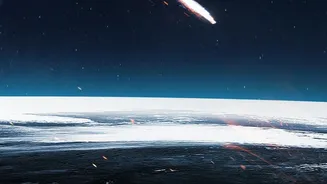


When a comet streaks across the night sky, its beautiful, flowing tail is what captures our imagination. But this celestial spectacle isn't just for show; it's the result of a dramatic transformation powered by the immense energy of our Sun.
Cosmic Snowballs on a Journey
At its heart,
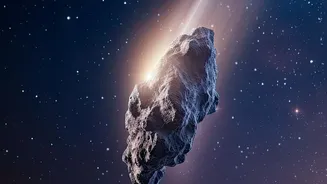
a comet is a relatively small celestial body, often described as a 'dirty snowball'. This core, called the nucleus, is a mixture of ice, rock, and frozen gases like carbon dioxide, methane, and ammonia, typically spanning just a few kilometres. These objects are ancient relics, leftovers from the formation of our solar system about 4.6 billion years ago. For most of their long, elliptical orbits, they exist as dark, frozen lumps in the frigid outer reaches of space, like the Kuiper Belt or the even more distant Oort Cloud. It is only when their path brings them into the inner solar system that their incredible metamorphosis begins.
Waking Up Near the Sun
As a comet journeys closer to the Sun, its surface begins to warm up dramatically. This solar heating causes a process called sublimation, where the frozen ices in the nucleus turn directly into gas without ever becoming liquid. These escaping gases erupt from the surface, carrying dust particles that were trapped within the ice along with them. This mixture of gas and dust forms a vast, hazy atmosphere around the nucleus known as the 'coma'. While the nucleus itself is small, the coma can expand to be enormous, sometimes even larger than planets like Jupiter or the Sun itself, giving the comet a fuzzy, distinct appearance that separates it from a star or asteroid.
Two Tails, Two Forces
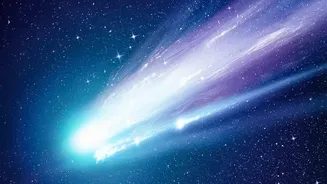
The brilliant tail we see is actually two separate tails, each formed and shaped by different forces emanating from the Sun. The first is the ion tail (also called a gas or plasma tail), and the second is the dust tail. Both originate from the material escaping the nucleus into the coma, but their compositions and the way they interact with the solar environment create two distinct and beautiful streams that trail behind the comet for millions of kilometres.
The Straight, Blue Ion Tail
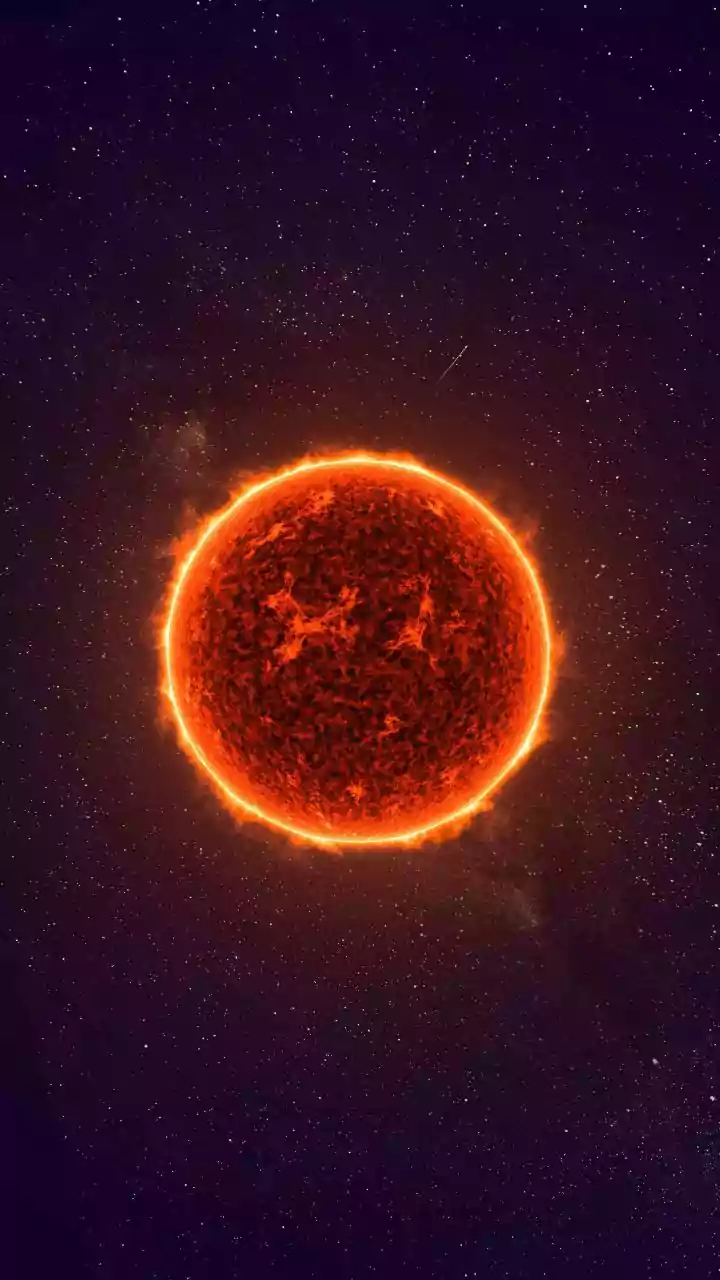
The ion tail is composed of gas molecules from the coma that have been energised by the Sun's ultraviolet radiation. This radiation is so powerful it strips electrons from the gas molecules, creating electrically charged particles, or ions. These lightweight ions are then caught and pushed away by the solar wind—a constant stream of charged particles flowing from the Sun. Because the solar wind moves at very high speeds, it forces the ion tail to point almost directly away from the Sun, regardless of which direction the comet is travelling. This tail often glows with a bluish light, a result of the ionised gas molecules, particularly carbon monoxide, fluorescing.
The Curved, White Dust Tail
The second tail is the dust tail, made of larger, solid particles that were mixed in with the ice. These dust particles are too heavy to be significantly affected by the solar wind. Instead, they are gently pushed away from the comet by the pressure of sunlight itself, a force known as solar radiation pressure. Because the dust particles are more massive and retain some of the comet's orbital momentum, they lag behind, forming a broader, more diffuse tail that often appears curved. This tail shines because the dust particles reflect sunlight, giving it a characteristic whitish-yellow colour. So, when you see a comet, you are witnessing two different tails being sculpted by two different solar forces.