





The Science of a Floating Island
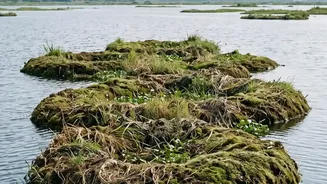
The phumdis of Loktak Lake are not mere rafts of weeds, but complex, living islands. They are heterogeneous masses of vegetation, soil, and organic matter in various stages of decomposition. These elements bind together over time to form thick, buoyant
mats that can range from a few centimetres to over two metres in thickness. Like icebergs, a significant portion of their mass lies below the water's surface. The natural life cycle of the phumdis involves sinking during the dry season, allowing their roots to touch the lakebed and absorb vital nutrients. This process is crucial for their survival and thickness, allowing them to support a rich variety of life.
A Floating National Park and its Star
The largest of these phumdis, spanning an incredible 40 square kilometres, hosts the Keibul Lamjao National Park, the world's only floating national park. This extraordinary sanctuary is the last natural habitat of the Sangai, Manipur's state animal. Often called the 'dancing deer', this endangered species has adapted to its unique environment, its graceful gait perfectly suited for navigating the spongy, trampoline-like surface of the phumdis. Once thought to be extinct, the Sangai was rediscovered in the 1950s, and its fragile recovery is now entirely dependent on the health of this one-of-a-kind floating ecosystem. The park is also a haven for other species, including hog deer, otters, and hundreds of species of birds.
Life on the Water
For generations, the Meitei fishing communities have built their lives on the phumdis. It is estimated that thousands of people live in floating huts, known as 'phumshangs', with a wider population of over 100,000 people depending directly or indirectly on the lake for their livelihood. Fishing is the primary occupation, with traditional techniques and knowledge passed down through centuries. These communities have developed a way of life entirely in sync with the lake's natural rhythms, cultivating vegetables on the islands and using specialised fishing methods adapted to the floating landscape. The lake is not just a source of income; it is the centre of their cultural and social identity.
An Ecosystem Under Pressure
Despite its beauty, Loktak Lake is an ecosystem in crisis, a fact recognised by its inclusion on the Montreux Record of threatened wetlands since 1993. The primary culprit is the Ithai Barrage, constructed in 1983 for a hydroelectric project. The barrage maintains a constantly high water level throughout the year, which has had devastating consequences. It prevents the phumdis from sinking to the lakebed during the dry season to absorb nutrients, causing them to thin, break apart, and decompose. This disruption has also flooded vast areas of surrounding farmland, forcing many to become entirely dependent on the overburdened lake. Furthermore, the barrage blocks the migration path of native fish species, decimating local catches, while pollution from inflowing rivers and agricultural runoff chokes the water, further threatening the delicate balance of life.
The Path to Preservation
The future of Loktak and its floating islands hangs in a delicate balance. The Loktak Development Authority (LDA) was established to oversee the lake's conservation, and the Manipur Loktak Lake (Protection) Act of 2006 provides a legal framework for its management. Efforts have included drives to remove excess phumdi and manage the catchment area. However, these actions have sometimes been controversial, leading to the displacement of floating communities. There is growing debate and even calls from the state government to consider decommissioning the Ithai Barrage to restore the lake's natural hydrology. For conservation to be successful, it must integrate the livelihoods of the local communities who have been the traditional custodians of the lake. Ultimately, saving Loktak requires a holistic approach that respects both its unique ecology and the people whose lives are intrinsically woven into its floating fabric.