

A New Window to Our Star
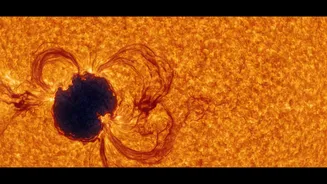
The breathtaking image comes from the National Science Foundation's Daniel K. Inouye Solar Telescope in Hawaii, the most powerful solar telescope on Earth. The headline may say NASA, and while NASA is a key partner in heliophysics, this specific image is a triumph
of the NSF's new observatory. Its massive four-metre mirror allows it to see details on the Sun's surface as small as 20-30 kilometres across. To put that in perspective, it’s like seeing an object the size of a small city from 150 million kilometres away. This unprecedented resolution is revealing phenomena that were once only theoretical, offering a new understanding of the star that makes life on our planet possible.
A Surface of Boiling Plasma
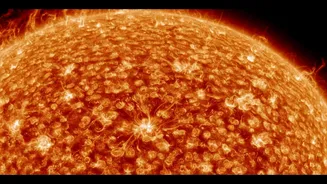
So, what are we actually looking at? The image shows a pattern of turbulent, 'boiling' plasma that covers the entire sun. These cell-like structures, each about the size of a large country like France or the state of Texas, are called granules. They are the tops of huge convection cells that carry heat from the Sun's interior to its surface. Think of it like a pot of boiling water: hot plasma rises in the bright, glowing centers of the cells, spreads out, cools, and then sinks back down in the dark lanes that border them. This entire process is incredibly dynamic, with each granule lasting only about 8 to 20 minutes before dissipating and being replaced by another. At any given moment, the sun's surface is covered by millions of these churning cells.
Hidden Swirls and Magnetic Secrets
Beyond the granules, these new, ultra-sharp images have confirmed something scientists had long predicted but never directly seen: a process called the Kelvin-Helmholtz instability. This phenomenon occurs when fluids or plasmas moving at different speeds slide past each other, creating a shear that rolls up into spiralling vortices, like waves breaking in the ocean. The Inouye telescope has spotted these tiny whirlpools, some just tens of kilometres across, at the edges of the granules. These swirls and the ultra-fine magnetic 'stripes' seen with them are more than just a curiosity. Scientists believe they play a crucial role in transferring energy from the Sun's surface into its outer atmosphere, the corona, which may help solve the long-standing mystery of why the corona is millions of degrees hotter than the surface below.
Why It Matters for Us in India
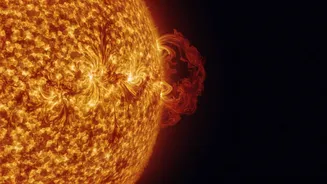
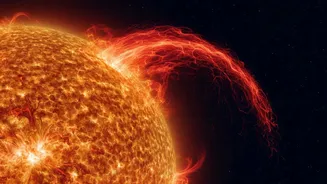
Understanding the Sun's 'restless surface' is not just an academic exercise. The same magnetic forces that create these tiny swirls can also power massive solar flares and coronal mass ejections (CMEs). When aimed at Earth, these eruptions of particles and radiation create 'space weather'. Severe space weather can be incredibly disruptive to our modern, tech-reliant society. It can damage critical satellites used for communications and weather forecasting, disrupt GPS navigation which is vital for aviation and shipping, and even induce currents that can overload and knock out power grids. For a nation like India, with its rapidly growing digital economy and reliance on satellite technology for everything from banking to agriculture, the ability to better predict these solar storms is a matter of national importance. Studying the Sun in this new, incredible detail is the first step toward creating more reliable space weather forecasts.