







A Lonely Outpost in the Cosmos
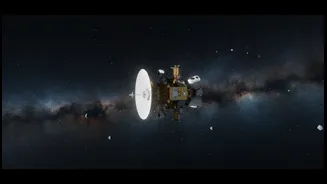
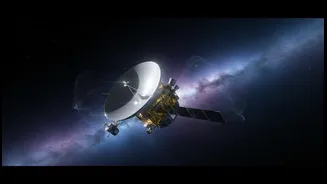
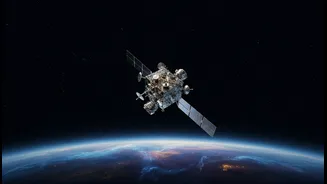
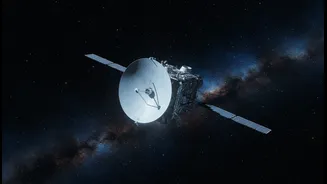
Launched in 2006, New Horizons became the fastest spacecraft ever dispatched, using a gravity assist from Jupiter to catapult itself towards Pluto. After successfully completing its primary mission in 2015 and a subsequent flyby of the Kuiper Belt object
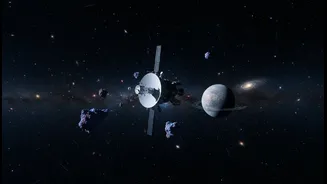
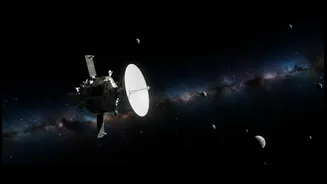
Arrokoth in 2019, the probe is now venturing through the vast, icy expanse known as the Kuiper Belt. As of July 2026, it is approximately 9.5 billion kilometres from Earth. This incredible distance means that its radio signals, travelling at the speed of light, take nearly nine hours to reach us. Recently, on July 7, 2026, NASA confirmed the probe had successfully awakened from a 321-day hibernation period, ready for its next scientific chapter.
Beyond the 'Familiar' Solar System
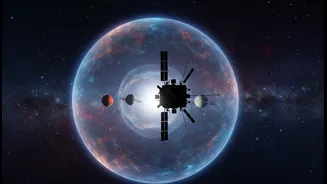
The “familiar solar system” is generally considered the region encompassing the planets. New Horizons is now operating in a fundamentally different environment: the outer heliosphere. The heliosphere is a vast, bubble-like region of space created by the constant stream of charged particles flowing from the Sun, known as the solar wind. This bubble acts as a shield, protecting the planets from intense galactic cosmic radiation. The outer edge of this bubble, where the Sun's influence wanes and interstellar space begins, is one of the most poorly understood regions of our cosmic neighbourhood. Only the two Voyager probes have crossed this boundary, and New Horizons is in a unique position to provide a new perspective.
What 'Rare Data' Can It Collect?
From its unique vantage point, New Horizons can gather data that is impossible to obtain from Earth or even from satellites in orbit. Its instruments are currently measuring the solar wind, the energetic particles, and the dust environment in the Kuiper Belt. This is crucial because New Horizons is the only spacecraft operating in this region equipped to make first-time measurements of certain particles, called pickup ions, which the Voyager probes could not. These measurements help scientists understand how the solar wind evolves and interacts with the interstellar medium. In the coming weeks, its ultraviolet spectrograph will begin observing the distribution of hydrogen gas at the solar system's edge, studying a feature known as the "hydrogen wall." This data will provide invaluable clues about the structure and dynamics of the heliosphere's boundary.
A Race Against Time
The mission is a long-term investment, but it faces a hard deadline. New Horizons is powered by a Radioisotope Thermoelectric Generator (RTG), which produces electricity from the heat of decaying plutonium. The power output of the RTG naturally decreases over time, by about 3.5 watts per year. While mission planners expect the spacecraft to have enough power to continue operating its science instruments into the 2030s, the clock is ticking. Scientists are focused on an extended mission that prioritizes heliophysics data until the probe exits the Kuiper Belt around 2028 or 2029. Each observation is carefully planned to maximize the scientific return before the probe's power source inevitably fades, turning one of humanity’s farthest explorers silent.