




An Ice Age Survivor
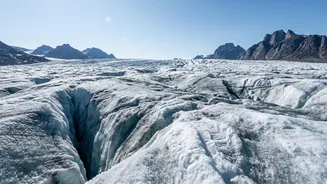
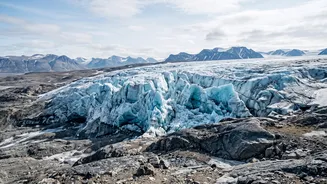
On Baffin Island in Nunavut, Canada, lies the Barnes Ice Cap, a feature roughly the size of Delaware. For thousands of years, it has persisted as a quiet monument to a very different world. It is the last surviving piece of the gigantic Laurentide Ice Sheet,
a mass of ice that, at its peak over 20,000 years ago, buried most of Canada and the northern United States under a layer up to three kilometres thick. The formation of the Great Lakes and countless other features of the North American landscape are the handiwork of this ancient ice sheet. As the Earth warmed and the last ice age ended, the Laurentide retreated, leaving the Barnes Ice Cap behind as its sole remnant about 8,500 years ago.
A Startling Discovery in the Ice
Recent research has provided a fascinating and somewhat startling twist in the ice cap's history. A study led by researchers from Columbia Climate School's Lamont-Doherty Earth Observatory revealed that after shrinking to its smallest size around 3,000 years ago, the Barnes Ice Cap began to grow again. About 2,000 years ago, as the climate naturally cooled, the ice began to re-expand, a process scientists say marked the subtle beginning of the next glacial period, or ice age. By studying ancient vegetation preserved and exposed by the ice's movement, scientists were able to piece together this timeline. This re-expansion continued for nearly two millennia, a natural process of planetary climate cycles.
An Ice Age Interrupted
The slow, steady growth of the new ice sheet came to an abrupt halt. Researchers found that around 1960, the trend reversed. The ice cap, which had been gaining mass, began to shrink. The reason was the rapid increase in summer temperatures driven by anthropogenic, or human-caused, global warming. What researchers found was that a new ice age had, in fact, already begun, but it was stopped in its tracks by the warming of the 20th century. According to geochemist Nicolás Young, it's a powerful example of how humans have jolted the Earth's natural climate system. This finding challenges previous models that suggested the next glacial period was still thousands of years away.
A Canary in the Coal Mine
Today, the Barnes Ice Cap is melting at an alarming rate. Scientists have observed thinning of about one metre per year and noted that since around 2010, the ice cap has effectively lost its 'accumulation zone'—the area where snowfall would typically survive the summer melt and add mass to the glacier. Summer melt seasons have become longer and more intense, with meltwater channels now scarring the surface from its highest point to its edges. While the complete disappearance of the Barnes Ice Cap would have a negligible direct impact on global sea levels, its fate is seen as a critical warning. Scientists refer to it as a 'canary in the coal mine', indicating that the current level of atmospheric warming is strong enough to melt a feature that has survived for millennia, even through past warm interglacial periods. Its demise suggests that larger ice masses, like the Greenland Ice Sheet, are also at significant risk.
An Unavoidable End
The future for this ice age remnant appears bleak. According to modelling studies, even under the most conservative scenarios for greenhouse gas emissions, the Barnes Ice Cap is doomed to disappear completely within the next few hundred years. Under a 'business-as-usual' emissions scenario, it could be gone in as little as 300 years. Its disappearance will mark the definitive end of the Laurentide Ice Sheet and a visible, final erasure of a key feature from the last glacial age. The fact that it is melting away now, during a period of relatively weak summer sun in the Earth's orbital cycle, underscores the unprecedented nature of current warming.