




Meet the 'Mega-Earth'
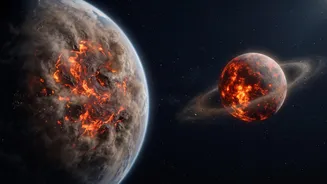
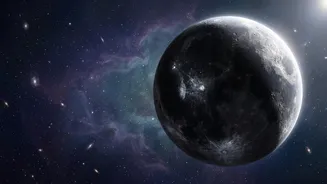
GJ 523b is an exoplanet located about 87 light-years from us, first flagged by NASA's Transiting Exoplanet Survey Satellite (TESS). What makes it stand out is its extraordinary combination of size and mass. It is about 2.5 times wider than Earth, but
it packs roughly 23.5 times our planet's mass into its frame. This has earned it the informal classification of a "mega-Earth," a term for unusually massive rocky worlds. Typically, planets are either small and rocky, like Earth, or large and gassy, like Neptune. GJ 523b exists in a strange middle ground. Its size would suggest it should be a "sub-Neptune," a planet with a substantial gaseous atmosphere. Yet, its immense mass tells a different story entirely.
The Density Dilemma
The core of the mystery lies in GJ 523b's density. By combining data on its size (from how much light it blocks from its star) and its mass (from the gravitational wobble it induces in that star), astronomers calculated its density to be approximately 7.8 grams per cubic centimetre. For comparison, Earth's density is about 5.5 g/cm³, and pure iron is around 7.9 g/cm³. This makes GJ 523b one of the densest planets known for its radius. This incredible density suggests the planet is composed almost entirely of rock and other heavy elements, with very little of the light, puffy atmosphere of hydrogen and helium that astronomers would expect a planet of its mass to have gathered. As one lead researcher noted, dense planets are not uncommon, but they are usually small like Earth or Mercury; seeing a planet this large and this dense was completely unexpected.
How Planets Are 'Supposed' to Form
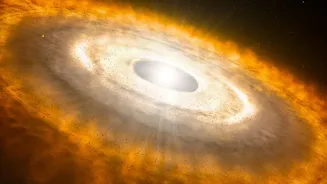
The prevailing theory of planet formation is called core accretion. It suggests that planets begin as small particles of dust and rock in a disk of material swirling around a young star. These particles stick together, growing into larger bodies called planetesimals. As a planetesimal's core grows more massive, its gravity becomes strong enough to attract and hold onto the vast amounts of hydrogen and helium gas in the surrounding disk, forming a thick atmosphere. Scientific models and observations of our own solar system suggest that once a planetary core reaches about 10 to 20 times the mass of Earth, it should begin a phase of rapid gas accumulation, quickly transforming into a gas giant like Jupiter or an ice giant like Neptune.
Why GJ 523b Breaks the Rules
GJ 523b is a planet that appears to have ignored its evolutionary instructions. At 23.5 times the mass of Earth, it is well past the threshold where it should have become a gas-shrouded world. Yet, it remains stubbornly rocky and dense. This raises a fundamental question for astronomers: why didn't it accumulate a massive atmosphere? The system it belongs to is also relatively young, at an estimated 170 million years old, adding another layer to the puzzle. The planet simply doesn't fit the standard model. Its existence suggests that our understanding of the planet-building process is incomplete and that there are alternative pathways for forming massive worlds.
Searching for a New Story
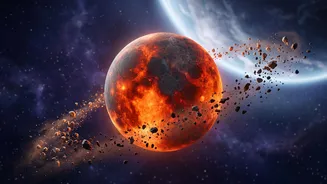
Scientists are now exploring more extreme and violent scenarios to explain GJ 523b's unusual nature. One possibility is that the planet did initially form a thick atmosphere, which was later stripped away by a massive impact or intense radiation from its star. Another theory involves a cataclysmic collision between two smaller planets, which could have merged their dense cores while blasting their lighter atmospheric layers into space. Further complicating the picture is the planet's orbit, which appears to be highly tilted relative to its star's equator, hinting at a turbulent past that may have involved gravitational disturbances from another, as-yet-unseen object. For now, GJ 523b remains an anomaly, a single data point that challenges broad theories. Astronomers will need to find more of these "mega-Earths" to determine if they are rare oddities or a common, previously unknown class of planet.