





The Full-Body Difference
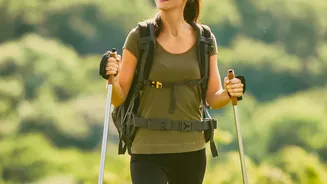
Unlike regular walking, which primarily engages the lower body, Nordic walking uses specially designed poles to actively involve your upper body muscles. By pushing off the ground with the poles, you engage your arms, shoulders, chest, and back. This
coordinated movement can activate up to 90% of your body's muscles, turning a simple walk into a highly effective, total-body exercise. Studies show this increased engagement leads to significant health benefits, including improvements in resting heart rate, blood pressure, and overall cardiovascular fitness. The result is a higher calorie burn—up to 40% more than regular walking—without feeling like you're working much harder.
Less Impact, Better Balance
One of the major advantages of Nordic walking is that it is gentle on the body. The poles help to distribute your weight more evenly, reducing the load and stress on your knees, hips, and back. This makes it an ideal activity for individuals with joint concerns or those looking for a low-impact form of exercise. The poles also provide additional points of contact with the ground, which improves stability and balance, especially on uneven terrain. This added support can boost confidence for seniors or anyone who feels unsteady on their feet.
Choosing the Right Poles
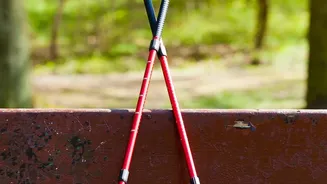
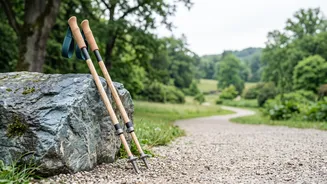
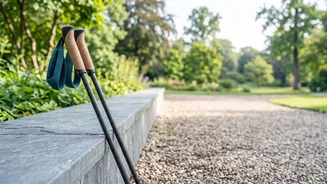
Your poles are not just accessories; they are your engine for propulsion. Selecting the correct length is crucial. Poles that are too long can strain your shoulders, while poles that are too short can cause you to hunch over and compromise your posture. A widely accepted formula for finding the right size is to multiply your height in centimetres by 0.68. For materials, carbon poles are often recommended for regular walkers because they are lightweight and absorb vibrations well, which is easier on your joints. Aluminium poles are more durable but can transmit more shock up your arms. Many beginners find adjustable-length poles useful, as they allow for fine-tuning.
Mastering the Basic Technique
Proper technique is what unlocks the full benefits of Nordic walking. It's built on the natural rhythm of walking. Start by maintaining an upright posture with a slight lean forward from your ankles, keeping your gaze ahead. The fundamental movement is oppositional: your right arm swings forward with your left leg, and your left arm with your right leg. The poles should be planted between your front and back foot at an angle, pointing backward. As you step forward, you push off the pole, extending your arm fully behind you. A key part of the technique involves opening your hand at the end of the push to relax your grip, then closing it as the arm swings forward again. This creates a smooth, flowing motion rather than a jarring, hiking-style plant.
Common Beginner Mistakes to Avoid
Many beginners make a few common errors that hinder their progress. The first is using the poles for support instead of propulsion by planting them too far forward. Remember to plant the poles at your side to push yourself forward. Another frequent mistake is poor coordination, where the arm and leg on the same side move together. To fix this, try dragging the poles by their straps for a few moments to rediscover your natural opposite-arm-and-leg swing. Finally, avoid keeping your arms bent at the elbow; the power comes from a full arm swing originating from the shoulder. A straight, relaxed arm swing ensures you engage the larger muscles of your upper body effectively.