



A Landmark Autonomous Landing
The latest mission in the Reusable Launch Vehicle (RLV) program, a series of landing experiments (LEX), showcased India’s growing mastery over complex autonomous technology. In the test, the winged vehicle, named 'Pushpak', was lifted to an altitude of 4.5
km by a Chinook helicopter and released. From there, it had to find its own way home. The vehicle autonomously navigated its way to the runway, corrected its course against deviations, and executed a precise, high-speed landing. This successful test, which built upon previous experiments, confirmed the viability of ISRO's indigenous navigation, control, and deceleration systems—all critical for a vehicle returning from orbit. Impressively, the mission reused the same winged body from a prior test, demonstrating the hardware's durability.
The Holy Grail of Spaceflight
For decades, rockets were single-use machines. The most expensive parts would burn up or be discarded in the ocean after just one flight. Reusable technology changes this paradigm entirely. By designing rockets that can return to Earth, land safely, and be prepared for another mission, the cost of accessing space can be slashed dramatically—by some estimates, by as much as 80%. This innovation is the primary driver behind the booming commercial space industry, pioneered by companies like SpaceX. Cheaper launches mean more satellites, more scientific missions, and new business models in orbit. For India, developing its own RLV is not just a matter of technological pride; it is a strategic necessity to compete in the burgeoning global space economy.
Meet Pushpak: India’s Space Shuttle
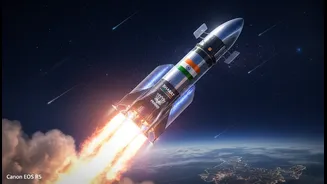
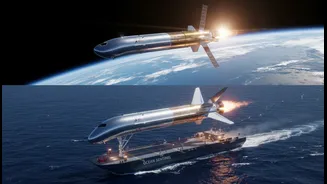
ISRO's RLV, affectionately named 'Pushpak' after the mythical flying chariot from the Ramayana, is a winged vehicle that looks more like an aircraft or the US Space Shuttle than the vertical-landing rockets of SpaceX. This design is intended to function as a flying testbed for evaluating a range of technologies, including hypersonic flight and autonomous landing. The vehicle that flew in the recent landing experiments is a scaled-down technology demonstrator. The ultimate goal is to scale it up to serve as the first stage of a two-stage orbital launch vehicle. This reusable first stage would carry the upper stage with the payload to a certain altitude before separating, flying back to Earth, and landing horizontally on a runway like a plane.
Fueling India's Commercial Ambitions
India is already a competitive player in the global launch market, known for its reliable and cost-effective PSLV rocket. However, the introduction of reusable technology will be a game-changer. By significantly lowering launch costs further, ISRO and Indian commercial partners can attract a larger share of the international satellite market. The Indian space launch services market is already projected to grow significantly, from over USD 435 million in 2023 to more than USD 1.6 billion by 2030. Success with 'Pushpak' will be a key enabler of this growth. It enhances India's self-reliance in space and positions it as a more attractive hub for global companies looking for affordable and reliable access to orbit.
The Long Road to Orbit
While the successful landing experiments are a major victory, the journey is far from over. These tests were conducted at subsonic speeds within the atmosphere. The next major challenge is the Orbital Re-entry Experiment (OREX). This will involve launching a vehicle to orbit, having it survive the intense heat of re-entry, and then perform an autonomous landing. ISRO plans to use a modified GSLV rocket to launch a larger version of the vehicle for this test in the coming years. Mastering hypersonic flight, thermal protection, and a deployable landing gear are among the many hurdles that still need to be cleared. The successful LEX missions have provided the crucial data and confidence needed to take these next ambitious steps toward a fully operational reusable launch system.