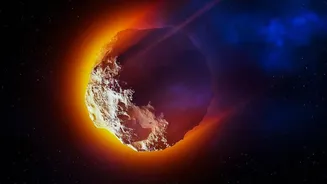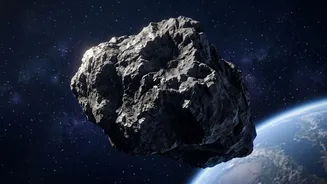







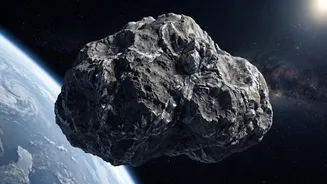
The idea of a giant asteroid hurtling toward Earth is the stuff of blockbuster films, but it is also a real-world threat that scientists take very seriously. Now, new research is refining our understanding of how we might defend ourselves.
The Planetary Defense Problem
For decades,
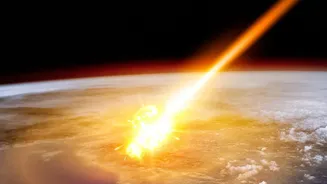
scientists and engineers have been developing strategies for planetary defense. The goal is to prevent a Near-Earth Object (NEO), such as an asteroid or comet, from colliding with our planet. An impact from a large enough object could cause catastrophic damage on a global scale. One of the leading concepts for deflecting an incoming threat is to use a nuclear device. The idea isn't to shatter the asteroid into countless pieces, which could create multiple new threats. Instead, the plan involves detonating a nuclear explosive at a standoff distance. The resulting burst of X-rays would instantly vaporize a thin layer of the asteroid's surface. This vaporized material would shoot off into space, creating a powerful push—like the exhaust from a rocket—that would nudge the asteroid onto a new, safer trajectory away from Earth.
From Perfect Spheres to Lumpy Reality
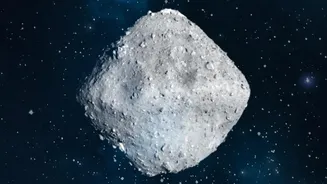
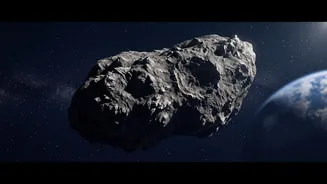
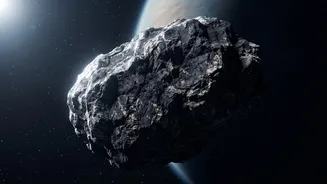
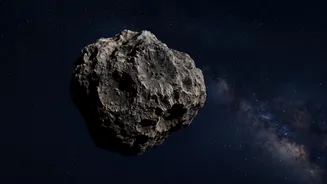
While the concept sounds straightforward, the physics are incredibly complex. For years, many simulations simplified the problem by modeling asteroids as perfect spheres. This made the calculations manageable for computers, but it had a significant flaw: as Sandia National Laboratories physicist Nathan Moore noted, 'spherical asteroids don't exist'. Real asteroids are irregular, lumpy bodies with ridges, craters, and uneven shapes. Recognizing this, Moore and his team at Sandia developed a new computer model to more accurately simulate what would happen when a real, irregularly shaped asteroid is hit with a blast of X-rays. By combining two different high-powered simulation codes, named ALEGRA and SPARTA, they created an algorithm that is over 1,600 times faster than previous methods, allowing for far more detailed and realistic analysis.
A Surprising New Spin
The results of these new, more realistic simulations, published in the journal Icarus, were striking. The researchers found that where the blast hits matters immensely. In one simulation, targeting one side of an asteroid produced a deflection velocity nearly five times greater than targeting another side of the exact same object. The change in the asteroid's speed was 3.9 millimeters per second from one direction, but just 0.8 millimeters per second from another. The effect on the asteroid's rotation was even more dramatic. For a different simulated asteroid, the change in its spin rate varied by a factor of 17 depending on the direction of the blast. 'We expected aim to matter,' Moore said in a statement. 'What surprised us was how much'. This happens because the lumpy surface means a blast from one side might efficiently push the rock, while a blast from another angle might just send it spinning faster, absorbing the energy without effectively changing its course.
Why This Finding Is Critical
This research has profound implications for planetary defense. It highlights that simply launching a nuclear device toward a threatening asteroid is not enough. A successful mission would require incredibly precise targeting. Mission planners would first need detailed 3D models of the asteroid's shape, likely gathered from a prior spacecraft flyby. The new algorithm allows scientists to upload that shape and run numerous simulations to find the optimal point of impact to achieve the desired nudge without causing it to spin uncontrollably or break apart. While the simulation is a major step forward, researchers note it currently only models the breakup of surface rocks and cannot yet accurately predict if the entire asteroid body would shatter—a key question for any real-world mission. Still, the ability to rapidly model these complex scenarios greatly reduces the guesswork, making a potential future defense mission more science and less luck.