





More Than Just Walking With Poles
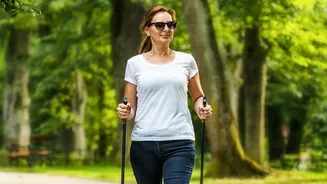
Originating in Finland as off-season training for cross-country skiers, Nordic walking is far more than just carrying sticks for balance. It’s an enhanced walking technique where you use specially designed poles to actively propel yourself forward. The
movement is specific: as you step with one foot, you plant the opposite pole behind you and push off, engaging your upper body in a way that mimics cross-country skiing. This transforms a lower-body exercise into a coordinated, full-body activity that engages up to 90% of your body's muscles, compared to about 50% with regular walking. This increased muscle recruitment is the key to unlocking its higher intensity.
Raising Intensity, Not Just Your Heart Rate
The core claim of Nordic walking is its ability to significantly raise exercise intensity. Research consistently backs this up. Studies show that compared to regular walking at the same speed, Nordic walking can increase calorie burn by 20% to 46%. This is because engaging the muscles of the arms, shoulders, back, and core requires more energy. Consequently, your body consumes more oxygen and your heart rate is higher than it would be during a normal walk, yet many people report that it doesn't feel significantly harder. It effectively bridges the gap between walking and jogging, providing a more robust cardiovascular workout without forcing you to break into a run.
A Balanced View on Joint and Heart Health
While some fitness trends make bold promises, the benefits of Nordic walking for joints and heart are grounded in mechanics and moderate intensity. For joints, the advantage is clear: it's a low-impact activity. The poles help distribute body weight and reduce some of the loading stress on the knees and hips, making it an excellent option for those with joint concerns or anyone looking to avoid the repetitive, high-impact forces of running, which can be 2.5 to 3.5 times your body weight. For heart health, the benefits come from its ability to elevate and sustain cardiovascular effort. One study found it to be more effective at improving functional capacity in patients recovering from cardiac events than even high-intensity interval training. A meta-analysis also concluded that it helps mitigate several cardiovascular risk factors in older adults, such as blood pressure and cholesterol.
The Alternative to Running
For those who find running too strenuous, inaccessible, or simply unenjoyable, Nordic walking presents a sustainable alternative. While running burns more calories per minute, Nordic walking's lower impact means you can often do it for longer durations and with greater frequency, potentially evening out the weekly calorie burn. It builds functional, upper-body strength in the back, shoulders, and arms, which can lead to improved posture—a benefit not typically associated with running. Furthermore, the poles provide additional points of contact with the ground, enhancing stability and balance, which is particularly beneficial for older adults or those unsteady on their feet.
How to Get Started
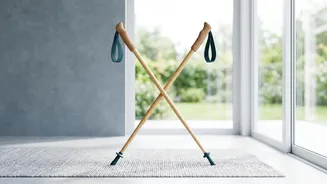
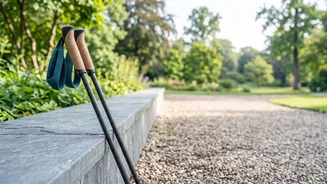
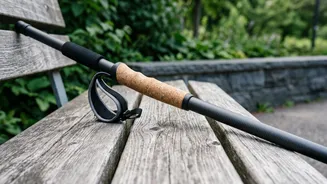
Getting started is straightforward but requires the right gear and technique. It's crucial to use poles specifically designed for Nordic walking, not trekking poles, which are built for stability rather than propulsion. These poles are lightweight and feature a special glove-like strap system that allows you to push off effectively. To learn the technique, focus on the basic rhythm: right arm and left leg forward, left arm and right leg forward. Swing your arms from the shoulder and plant the pole angled backward, behind your body. As your arm swings back, open your hand to push through the strap. Many find it helpful to start by dragging the poles to get a feel for the motion before progressing to actively planting them. For best results, consider a lesson from a certified instructor to ensure you're maximizing the benefits and avoiding bad habits.