




What Exactly Is a 'Fire Rainbow'?
First, a bit of myth-busting. The captivating term 'fire rainbow' is a misnomer; the phenomenon has nothing to do with fire, and it isn't a rainbow in the traditional sense. The correct scientific name is a circumhorizontal arc. Unlike a normal rainbow,
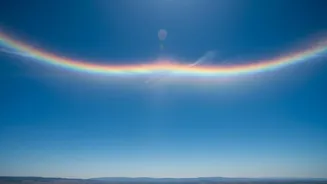
which is caused by the refraction and reflection of light in water droplets, a circumhorizontal arc is an optical effect caused by light refracting through ice crystals. These arcs appear as broad, colourful bands running parallel to the horizon, often so large that observers only see a fragment, making the clouds appear to be painted with iridescent, flame-like colours. This appearance is likely what led to its dramatic, if misleading, nickname.
The Three Essential Ingredients
For this spectacular light show to occur, the sky needs a very specific recipe with three key ingredients. First, you need the right kind of clouds. The phenomenon only happens in high-altitude cirrus clouds, which are thin, wispy clouds floating so high in the troposphere that they are composed of millions of tiny ice crystals instead of water droplets. Second, these ice crystals must be shaped like flat, hexagonal plates and be oriented horizontally, parallel to the ground. This uniform alignment allows them to act collectively like a giant, dispersed prism in the sky. If the crystals are randomly oriented, the effect doesn't happen.
The Sun's Angle Is Everything
The third and most critical ingredient—and the focus of NASA's recent highlight—is the position of the sun. For a circumhorizontal arc to form, the sun must be extremely high in the sky, specifically at an elevation of 58 degrees or greater above the horizon. This high angle is necessary for the sunlight to enter the vertical side-face of the hexagonal ice crystals and exit through the bottom horizontal face. This 90-degree path bends the light, splitting it into the pure, vibrant colours of the spectrum. If the sun is lower than 58 degrees, the geometry is wrong, and the light won't refract in the correct way to produce the arc. This precise angular requirement is the main reason why fire rainbows are so rare.
NASA's Picture Puts It in Perspective
NASA's Astronomy Picture of the Day (APOD) recently featured a striking photograph of a circumhorizontal arc, bringing renewed attention to the specific conditions required for its formation. The image, taken over West Virginia, beautifully showcases the flame-like appearance of the phenomenon in a patchy cirrus cloud. By explaining the image, NASA emphasizes that the visibility of such an arc is entirely dependent on the sun's high elevation, alongside the presence of correctly shaped and aligned ice crystals. The feature serves as a public-friendly explainer, using a captivating visual to teach the core principles of atmospheric optics and reinforce why the sun's angle isn't just a factor, but the deciding factor, in whether we see a fire rainbow.
An Exclusive Mid-Latitude Show
The strict 58-degree rule for the sun's elevation also means that this is one of the few atmospheric phenomena that cannot be seen from everywhere on Earth. In locations at latitudes north of 55°N or south of 55°S, the sun never gets high enough in the sky for a circumhorizontal arc to form. For those in the mid-latitudes, the best chance to spot one is during the summer months around midday, when the sun reaches its highest point in the sky. Even then, you still need the cirrus clouds to be present and perfectly constituted. The rarity of all these conditions aligning at once is what makes spotting a fire rainbow such a special event.