




Our Cosmic Neighbour's Big Secret
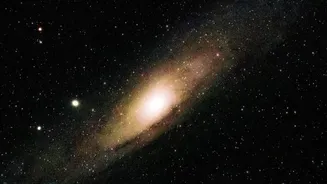
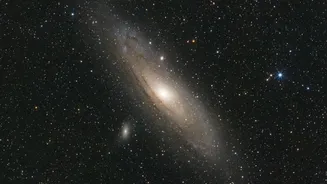
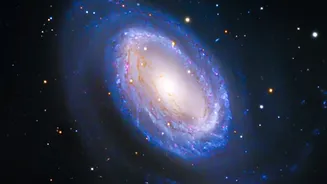
Just 2.5 million light-years away, the Andromeda galaxy is our closest major galactic neighbour and a stunning sight in the night sky. For decades, we've viewed it as a sibling to our own Milky Way. Yet, a recent, incredibly detailed study using NASA's
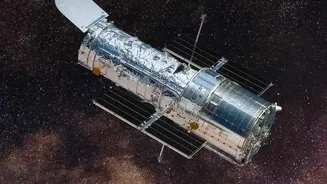
Hubble Space Telescope has peeled back a layer, showing that Andromeda is entering a new, quieter phase of its life. A new analysis has revealed that the galaxy’s production of new stars has been steadily decreasing for the last 500 million years, with an even more significant drop in the last 40 million years. This slowdown suggests Andromeda is transitioning from a lively youth into a more sedate middle age.
Reading the Fossil Record of Stars
So, how can astronomers look at a galaxy and know its history? They read the stars, which act as a 'fossil record' of a galaxy's past activity. The key is color. Massive, young stars burn hot and fast, giving off a brilliant blue light, but they don't live very long. Smaller, less massive stars are redder and can live for billions of years. By mapping the locations of blue versus red stars, scientists can determine which areas have recently been active star factories and which have been quiet for a long time. The new study accomplished this on an unprecedented scale, combining data from two huge Hubble surveys—the Panchromatic Hubble Andromeda Treasury (PHAT) and its southern counterpart (PHAST)—to map about 200 million individual stars across two-thirds of Andromeda's disk.
From a Boom to a Whisper
This new research builds on previous findings that Andromeda experienced a massive star-making boom about two billion years ago, likely caused by merging with a smaller galaxy. That event created a huge portion of the stars we see in the galaxy today. The new data shows what happened next: a long, steady decline. Five hundred million years ago, Andromeda was forming stars at a rate of about one solar mass (the mass of our Sun) per year. By 40 million years ago, that rate had dropped by half. Today, it has plummeted to just one-fifth of a solar mass per year. It’s not that the galaxy has run out of the gas and dust needed to make stars; rather, it appears to be naturally winding down after its previous, more energetic phase.
A Fading Ring of Fire
The slowdown isn't happening uniformly across the entire galaxy. Astronomers found that most of the recent star formation has been happening in a giant ring of gas and dust located about 32,000 light-years from the galactic centre. It is the decreasing activity within this specific ring that is driving most of the galaxy-wide decline. In another interesting twist, scientists noticed that one region near Andromeda's small satellite galaxy, M32, showed an even more pronounced slowdown starting around 60 million years ago. While they can't prove a direct link, the timing and location make M32 a prime suspect for having disturbed the gas in that area, further suppressing star birth.
What This Means for the Future
Understanding Andromeda’s life cycle is crucial because it’s the best external model we have for a large spiral galaxy like our own Milky Way. By studying its past, we learn about the forces that shape galaxies over billions of years. This discovery also adds a fascinating chapter to the story of our cosmic future. The Milky Way and Andromeda are on a collision course, set to merge in about 4.5 billion years. This study gives us a clearer picture of the state of our galactic partner before this dramatic cosmic event. When they do eventually merge, the collision will likely trigger a massive new burst of star formation, rekindling the fires that are currently beginning to fade in Andromeda.