




The Dawn of an 'Age of Abundance'
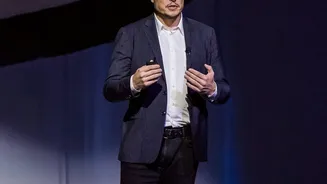
At a recent White House meeting with tech leaders, Elon Musk painted a picture of a future radically different from our present. He predicts that the rapid advancement of artificial intelligence and robotics will usher in an “age of abundance.” In this
scenario, machines are capable of producing nearly all goods and services, driving costs so low that scarcity becomes a thing of the past. This isn't just about providing a safety net; Musk's vision goes beyond Universal Basic Income (UBI). He speaks of “Universal High Income” (UHI), where the sheer productivity of an automated economy allows everyone to enjoy a high standard of living. This includes access to healthcare that could be better than what even the wealthiest have today, as AI and robots could perform sophisticated medical tasks.
When a Job Becomes Optional
The foundation of this abundant future is a fundamental shift in the role of human work. Musk has stated that within the next two decades, working could become entirely optional. He argues that just as electronic computers replaced the human job of being a “computer,” AI will transform most, if not all, professions. This isn't necessarily a prediction of mass unemployment, but rather an evolution of what it means to have a job. The purpose of work may shift from a necessity for survival to a hobby or a personal choice. However, Musk also acknowledges the psychological challenge this presents. He has openly wondered how people will find meaning and purpose in a world where an AI can do their job better than they can, a concern that adds a layer of complexity to his otherwise utopian vision.
The New Pillars: Arts, Science, and Engineering
If work becomes optional, how should young people prepare? Musk's advice is to build a broad base of knowledge across three key areas: arts, science, and engineering. This might seem counterintuitive, especially the emphasis on arts and humanities. However, his reasoning is directly tied to the capabilities of advanced AI. He believes that as AI handles the 'how' of execution, the most valuable human contribution will be the 'what' and the 'why.' To direct these powerful AI tools effectively, one needs a deep and varied understanding of the world. Specialized skills will still be necessary, but the true advantage will come from the ability to connect ideas across different domains.
Why Engineering and Science Still Matter
Even with AI performing many tasks, the need for human expertise in science and engineering will not disappear. Instead, it will move to a higher level. The focus will shift from executing routine tasks to designing, directing, and overseeing the complex AI and robotic systems. Think of it as the difference between being a construction worker and being the architect who envisions the building. Human engineers and scientists will be responsible for pushing the boundaries of what is possible, solving new problems, and ensuring that the technology being built is safe and beneficial for society. A deep understanding of the fundamental principles of the physical and digital worlds will be crucial for guiding our powerful new tools.
The Enduring Value of the Arts
Musk’s most surprising piece of advice may be his strong recommendation to study the arts and humanities. The logic is that in a world of technical abundance, uniquely human qualities like creativity, critical thinking, and cultural understanding become more valuable. When an AI can solve a technical problem, it is the person who understands history, psychology, and ethics who can ask whether the problem is worth solving in the first place. Musk calls this the ability to formulate the right question, a kind of “prompt engineering” for the real world. A broad education that includes the arts provides the context needed to ask better questions and to give AI tasks that are not just technically possible, but also meaningful and beneficial to humanity.
A New Path for India's Youth
For a nation like India, with its demographic dividend and strong focus on STEM education, Musk's perspective offers both a challenge and an opportunity. While technical proficiency remains important, his advice suggests that it is not enough on its own. The future may belong to those who can blend technical skills with creative thinking and a broad understanding of the world. This calls for a potential re-evaluation of educational priorities, encouraging interdisciplinary learning that combines science with arts and engineering with ethics. For young Indians aiming to thrive in the coming decades, the message is clear: specialize, but do not become so narrow that you lose the ability to see the bigger picture. The ability to adapt, learn across fields, and know what to ask of our technology will be the ultimate skill.