



The Classic Story of a Cosmic Crash
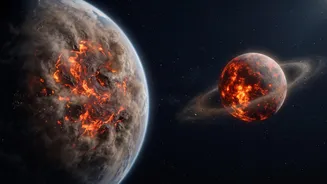
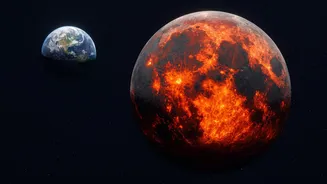
For the better part of half a century, the leading theory for the Moon's origin has been the Giant-Impact Hypothesis. The story goes that about 4.5 billion years ago, the early solar system was a chaotic place. A young, molten Earth was struck a glancing
blow by a Mars-sized planet, which scientists have named Theia, after the Greek titan who was mother to the Moon goddess, Selene. This cataclysmic collision would have obliterated Theia and blasted a huge amount of vaporised rock and debris from both bodies into orbit around Earth. Over thousands, if not millions, of years, this swirling ring of material would have slowly clumped together, eventually coalescing through gravity to form the Moon we see today. This theory explained a lot, including the Moon's size, its orbit, and why lunar rocks brought back by Apollo astronauts showed similarities to Earth's mantle.
A New, Faster Origin Story
That long-held story is now being challenged by a far more dramatic and rapid alternative. Recent, incredibly high-resolution supercomputer simulations are showing a different possibility: the Moon may have formed almost immediately after the impact, in a matter of hours. Researchers at institutions like NASA and Durham University ran simulations that were more detailed than ever before, revealing that under the right conditions, the impact could have launched a massive, largely intact body directly into a stable orbit. This isn't just a minor tweak to the old theory; it’s a radical reimagining of one of the most significant events in our planet's history. Instead of a slow, gradual assembly from a dusty, molten ring, our celestial companion might have been born nearly whole in less time than a single workday.
What the Supercomputers Showed
So what changed? Earlier simulations often treated the colliding planets like fluids, which was a necessary simplification given the computing power available. The new research, however, was able to model the early Earth and Theia as geological bodies with material strength. This seemingly small change had a massive effect on the outcome. The simulations revealed that the temperature of the impacting planets was a crucial factor. If Theia was hot enough, the collision would indeed create a debris disk as previously thought. But if Theia was cooler and therefore stronger, the impact could shatter it in such a way that a large, intact fragment—a proto-Moon—was thrown into orbit almost instantly. Some simulations showed a Moon-mass satellite forming in as little as five hours.
Solving Long-Standing Lunar Puzzles
This “immediate Moon” scenario is exciting not just because it's faster, but because it potentially solves some nagging problems with the classic theory. One major puzzle has been the near-identical isotopic composition of Earth and Moon rocks. If the Moon formed mostly from the debris of Theia, it should have a different chemical fingerprint than Earth. But it doesn't. The immediate-formation model suggests the outer layers of this new Moon would be made of material from the proto-Earth, which was thrown out during the impact, neatly explaining the similarity. This new model can also better account for the Moon’s tilted orbit and its surprisingly thin crust, features that have been difficult to reconcile with a slow, debris-disk formation.