




The Midnight Hour
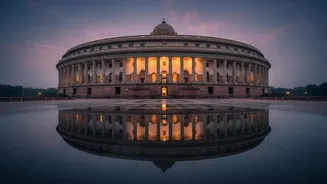
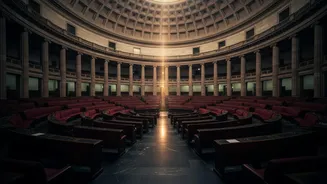
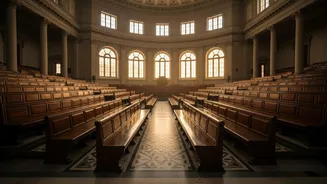
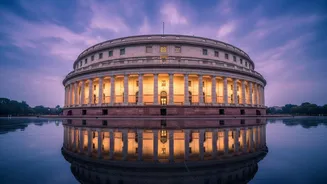
Inside the brightly lit Parliament House, the Constituent Assembly met at 11 p.m. on August 14 for a momentous session. Chaired by President Dr. Rajendra Prasad, the proceedings began with the singing of Vande Mataram by Sucheta Kriplani. The air was
thick with anticipation. Just before midnight, Jawaharlal Nehru, soon to be the first Prime Minister, rose to deliver his iconic "Tryst with Destiny" speech. "At the stroke of the midnight hour, when the world sleeps, India will awake to life and freedom," he declared. His words, broadcast to a massive crowd waiting outside, marked the formal end of an age and the assumption of power by a sovereign Indian body. The members then took a pledge of dedication to the service of the nation.
A New Dawn in Delhi
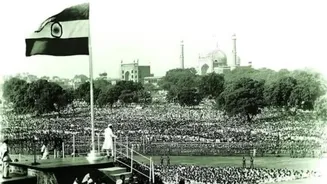
The morning of August 15, 1947, was a whirlwind of official ceremony. Though a light drizzle had fallen overnight, the day dawned clear. In the morning, Lord Mountbatten was sworn in as the first Governor-General of the new Dominion of India, after which he swore in Nehru as Prime Minister and his first cabinet. The day's main public event was the flag hoisting ceremony at Princess Park near India Gate. An immense, unmanageable crowd gathered, a sea of humanity eager to witness the birth of their nation. People climbed onto anything they could find for a better view. Lord Mountbatten and Nehru arrived to a scene of frenzied enthusiasm, making it difficult even for dignitaries to reach the dais. The Tricolour was raised, symbolising the official transfer of power in the eyes of the public.
A Nation Celebrates
The official ceremonies were just the heart of a nationwide celebration. In Delhi, Bombay, Calcutta, and Madras, streets overflowed with people. All traffic rules were forgotten as cars, buses, and trams were swamped with celebrating citizens, many perched precariously on roofs. The air was filled with the sound of conch shells, fireworks, and patriotic slogans like “Mahatma Gandhi ki Jai!”. In an incredible display of unity, temples and mosques opened their gates to all, distributing sweets as Hindus and Muslims celebrated together in many cities. Many people had stayed up all night, listening to the radio and participating in the spontaneous joy that swept through cities and towns. It was a carnival of freedom, a moment of pure, unbridled emotion for millions.
The Shadow of Partition
But the joy was not universal. While Delhi celebrated, the architect of the non-violent freedom struggle, Mahatma Gandhi, was in Calcutta, fasting and appealing for peace between Hindus and Muslims amidst the carnage of Partition. The joy of independence was inextricably linked to the profound sorrow of division. For millions in Punjab and Bengal, August 15 was not a day of celebration but of terror, displacement, and violence. Families were uprooted and communities were torn apart as one of the largest mass migrations in human history unfolded under a cloud of fear. Nehru himself alluded to this pain in his midnight speech, acknowledging that their hearts were heavy with the memory of sorrow. This duality—of joyous freedom and the brutal cost of Partition—is the unshakeable context of that historic day.