



An Expanded Bloc, A Broader Ambition
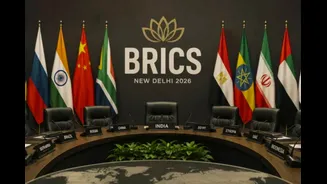
The BRICS of 2026 is a far cry from the original quintet. With the addition of Egypt, Ethiopia, Iran, Saudi Arabia, the UAE, and Indonesia, the bloc now represents nearly half the world's population and roughly 40% of global GDP. This expansion isn't
just about numbers; it's about strategic depth. The inclusion of major energy exporters and key maritime hubs fundamentally reshapes the group's economic gravity. India, holding the chairship in 2026, has guided this expanded group under the theme “Building for Resilience, Innovation, Cooperation and Sustainability.” The focus is on moving beyond high-level talks to tangible cooperation in areas like trade, technology, and finance, aiming to create a more robust economic framework for the Global South.
Beyond the Dollar: A Pragmatic Push for Financial Autonomy
Talk of “de-dollarization” often dominates BRICS headlines, but the reality in 2026 is more nuanced. While a common currency remains a distant and unlikely prospect, the central proposition is to foster a multi-currency financial world. The strategy focuses on increasing the use of local currencies for trade settlement between member nations. This approach aims to reduce transaction costs, insulate economies from the volatility of the US dollar, and limit exposure to US monetary policy and sanctions. Initiatives like the proposed BRICS Cross-Border Payment Initiative and linking domestic fast payment systems are the practical building blocks of this strategy. India, for instance, sees this as an opportunity to promote the international use of the rupee. However, the dollar's dominance remains formidable, still accounting for the majority of global trade invoicing and reserves, making this a gradual erosion rather than a revolution.
Building the Future: The Role of the New Development Bank
At the heart of the investment push is the New Development Bank (NDB). Its 2022-2026 strategy focuses on “Scaling Up Development Finance for a Sustainable Future.” The bank has set a target of approving USD 30 billion in financing during this period, with a significant portion dedicated to climate-resilient projects and energy transition. A key goal is to increase lending in local currencies to 30% of its portfolio, which helps shield member countries from exchange rate risks. The NDB has already approved over USD 42 billion for nearly 140 projects since its inception, funding critical infrastructure in transport, clean energy, and water sanitation. This focus on sustainable infrastructure is a core part of the BRICS proposition to foster long-term, resilient growth.
India's Strategic Balancing Act
For India, the 2026 BRICS agenda presents both opportunities and challenges. As chair, New Delhi has skillfully steered the conversation towards practical economic outcomes rather than geopolitical confrontation. India is championing initiatives to support its Micro, Small, and Medium Enterprises (MSMEs) through proposals like a BRICS invoice discounting mechanism to ease access to trade finance. The push for a BRICS Global Value Chains Action Plan aligns with India's goal to boost its manufacturing sector and create more resilient supply chains. However, navigating the internal dynamics of an expanded BRICS, which includes strategic rivals like China and countries with conflicting regional interests like Iran and Saudi Arabia, requires a delicate balancing act. India's leadership aims to keep the bloc focused on a shared development agenda while managing these inherent geopolitical complexities.
From Ambition to Reality: The Road Ahead
The central proposition of BRICS in 2026 is ambitious: to create a parallel, not necessarily oppositional, economic ecosystem that offers its members greater strategic autonomy. The roadmap laid out by the BRICS CCI emphasizes creating practical B2B networks and simplifying cross-border regulations. However, significant hurdles remain. Intra-BRICS trade, while growing rapidly, still only accounts for a small fraction of global trade, and China's dominance within the group creates imbalances. Deep-seated political differences among members, particularly between India and China, could slow down deeper integration. Furthermore, building trust in new financial systems takes time. While the infrastructure is being laid, achieving the scale to truly challenge established systems is a long-term project. The success of the 2026 push will depend on whether the bloc can translate its strategic vision into concrete, mutually beneficial outcomes for all its diverse members.