








A Reshaped Lunar Roadmap
In the world of deep-space exploration, plans evolve. NASA has recently overhauled its Artemis program timeline to accelerate its goals for a sustainable lunar presence. Following the initial uncrewed and crewed test flights, the agency is now targeting
2028 for two separate crewed landings on the lunar surface. The first landing, named Artemis IV, is scheduled for early 2028, and will be followed by Artemis V in late 2028. This aggressive schedule underscores a significant strategic shift: instead of slowly building up capabilities, NASA is aiming for a rapid succession of missions to fast-track the establishment of a long-term outpost on the Moon. The original plan to land with Artemis III has been repurposed into a 2027 orbital test mission, clearing the way for 2028 to become the year of landings.
Artemis IV: Humanity's Return to the Surface
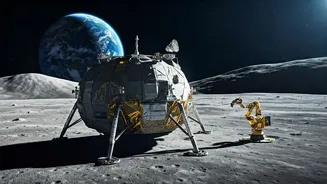
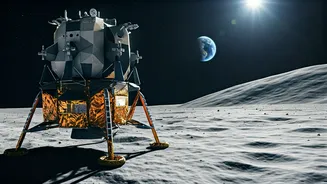
The first major event of 2028 will be Artemis IV, marking the first time humans will have walked on the Moon since the Apollo 17 mission in 1972. Four astronauts will journey to lunar orbit aboard the Orion spacecraft. From there, two crew members will transfer to a specialized Human Landing System (HLS), developed by one of NASA’s commercial partners like SpaceX or Blue Origin, for the historic descent to the lunar South Pole. This region is of immense scientific interest because it is believed to hold deposits of water ice in its permanently shadowed craters. The astronauts will spend approximately a week on the surface, conducting experiments, collecting samples, and deploying scientific instruments that will help us better understand the Moon's environment and resources.
Artemis V: Laying the Foundation for a Base
If Artemis IV is about returning, Artemis V, planned for late 2028, is about staying. This mission is when NASA is expected to begin the first concrete steps toward building the Artemis Base Camp. While also a landing mission, its primary focus will shift towards deploying the initial infrastructure needed for a permanent habitat. This could include delivering larger pieces of equipment, such as a rover or early habitat components, using cargo versions of the commercial landers. The goal is to move beyond the short-stay missions of the Apollo era and lay the groundwork for crews to eventually live and work on the Moon for up to two months at a time.
The Vision for Artemis Base Camp
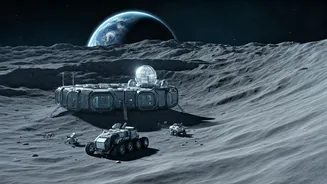
So, what will this Moon base look like? The concept for the Artemis Base Camp is a multi-element outpost located at the lunar South Pole. The vision includes three core components: a foundational surface habitat that can house four astronauts; a Lunar Terrain Vehicle (LTV), an unpressurized rover for transporting astronauts on shorter trips; and a Habitable Mobility Platform, essentially a pressurized camper van that would allow for long-range exploration trips of several weeks. A key objective of the base is to test technologies for In-Situ Resource Utilization (ISRU), which means learning to live off the land by extracting resources like water ice and oxygen from the lunar soil. This is a crucial step for long-term sustainability and for future missions to Mars.
A Global Effort for a New Era
NASA isn't going to the Moon alone. The Artemis program is a massive international and commercial collaboration. Dozens of countries, including Canada, Japan, and European nations, have signed the Artemis Accords, a set of principles for peaceful and cooperative space exploration. These international partners are contributing critical hardware, from robotic arms to habitation modules. Simultaneously, NASA is leaning heavily on private companies like SpaceX and Blue Origin to build the lunar landers, and other companies to deliver cargo and supplies. This global partnership approach not only shares the immense cost and complexity but also fosters a new era of collaborative deep-space exploration, creating a framework for peaceful operations on other celestial bodies.