

A New Look at a Celestial Lion
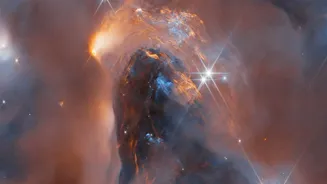
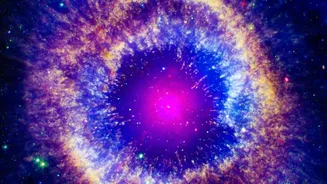
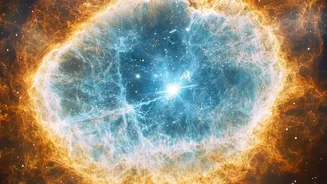
Floating approximately 4,200 light-years away in the constellation Gemini is a celestial marvel known as NGC 2392. While it has also been nicknamed the Eskimo Nebula or the Clown-faced Nebula, recent imagery has emphasized its resemblance to a lion's
head, complete with a flowing mane. This object is a planetary nebula, the glowing shell of gas and dust cast off by a dying star. Astronomers have studied it for years, but the James Webb Space Telescope (JWST) has just provided a view of unprecedented detail, cutting through the haze to reveal the intricate dynamics at play. While previous images from telescopes like Hubble showed its basic shape, Webb's infrared vision has peeled back the layers, highlighting features that were previously hidden.
The Story of a Dying Star
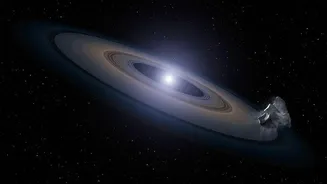
Despite the name, it has nothing to do with planets. It’s the final, flamboyant act for a star with a mass similar to our Sun. When such a star exhausts the nuclear fuel in its core, it becomes unstable and sheds its outer layers into space. What's left behind is a tiny, incredibly hot and dense core called a white dwarf. This stellar remnant, located at the very center of the nebula, acts like a cosmic furnace. It blasts out intense radiation that 'cooks' the surrounding gas and dust it just ejected, causing it to glow and expand. In the case of the Lion Nebula, this process has been shaping the cloud of gas and dust for thousands of years.
Filaments and Clumps Hidden in the Mane
The latest images from Webb are remarkable because they show a cosmic battle between creation and destruction. The central white dwarf is unleashing a torrent of energy, creating a bubble of superheated, ionized gas that forms the 'face' of the lion. This bubble is relentlessly expanding, destroying finer dust particles in its path. But Webb’s new view reveals something incredible within the 'mane'—the outer shell of the nebula. It has uncovered fine, filamentary structures and dense, clumpy clumps of dust that are managing to survive the onslaught. These resilient dust structures look like fluffy tufts or even have comet-like tails. They are so dense that they withstand the star's radiation, in turn shielding the material behind them from being completely eroded away.
Why This Cosmic Dust Matters
This discovery is more than just a pretty picture; it provides a 'frozen-in-time' snapshot of a crucial, universal process. The complex rings and shells seen in the Lion Nebula are common features in planetary nebulae, and understanding how they form is an ongoing quest for astronomers. By seeing which dust structures survive and which are destroyed, scientists can better model how these beautiful objects get their intricate shapes. This process is also fundamental to our own existence. Much of the observable dust in the universe, containing heavier elements forged inside stars, is produced and scattered through space by dying stars in this exact way. This recycled material eventually becomes the building blocks for new stars and planets.
An Ephemeral Masterpiece
The stunning scene Webb has captured is fleeting on a cosmic timescale. The gas and dust of the Lion Nebula will continue to expand and drift away from the central white dwarf. Astronomers estimate that in about 10,000 years, the entire structure will have dispersed into interstellar space, leaving only the cooling white dwarf behind. For now, however, Webb's instruments have given us an unparalleled glimpse into this dynamic environment. It shows us that even in death, stars can create objects of incredible complexity and beauty, offering vital clues about the life cycle of stars and the constant churn of matter throughout the universe.