




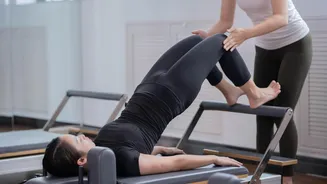
The plank is a powerhouse exercise, but holding the same static position can get stale. Pilates introduces dynamic variations that challenge your muscles in new ways, building a truly resilient core and improving whole-body stability.
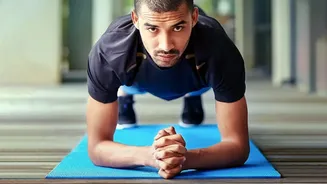
The Foundation: Forearm Plank
Before exploring
variations, it's crucial to master the classic. The forearm plank is a foundational move in both fitness and Pilates. It targets the entire core, including the deep transverse abdominis, rectus abdominis, obliques, and lower back muscles. To perform it, lie on your stomach and prop yourself up on your forearms with your elbows directly under your shoulders. Engage your core by drawing your navel towards your spine, keep your body in a straight line from head to heels, and press your glutes. Avoid letting your hips sag or rise too high. A strong, stable plank here is the key to safely advancing to more complex movements.
Challenge Your Obliques: Side Plank
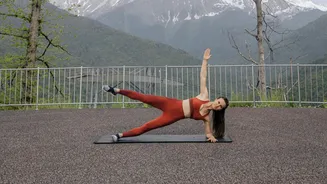
The side plank specifically targets the obliques, the muscles along the sides of your torso that are crucial for rotational control and spinal stability. To start, lie on your right side and prop yourself up on your right forearm, ensuring your elbow is aligned under your shoulder. Stack your feet or place your top foot in front of the bottom one for more stability. Lift your hips off the floor, creating a straight line from your head to your feet. You'll feel this working not just your side-waist, but also your shoulder and hip stabilisers. Hold for 20-45 seconds before carefully lowering and repeating on the left side.
Add a Dynamic Twist: Side Plank with Leg Lift
Once you're comfortable with the static side plank, adding a leg lift introduces a new stability challenge. This variation increases the demand on your gluteus medius and lateral hip stabilisers. From a stable side plank position, keep your core engaged and slowly lift your top leg straight up toward the ceiling without bending the knee. The key is to move with control and prevent your hips from rotating or dropping. Slowly lower the leg back to the starting position. This move not only strengthens the obliques and glutes but also enhances your balance and coordination.
Build Posterior Strength: The Reverse Plank
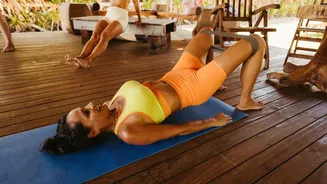
While most planks focus on the front of the body, the reverse plank targets your entire posterior chain—the glutes, hamstrings, and lower back. It also provides a great stretch for your shoulders and hip flexors. To do it, sit on the floor with your legs extended in front of you. Place your hands on the floor behind you, fingers pointing towards your feet. Press into your hands and heels to lift your hips toward the ceiling, forming a straight line from your shoulders to your heels. Keep your core and glutes engaged to prevent your hips from sagging. This exercise is excellent for improving posture by strengthening the muscles that help you stand tall.
Master Full-Body Coordination: The Swimming Plank
Known in Pilates as 'Swimming', this is a dynamic exercise that enhances back strength and coordination. Lie on your stomach with your arms and legs fully extended. Engage your core, pulling your navel away from the mat. Inhale to lift your head, chest, arms, and legs just a few inches off the floor. From here, begin to 'flutter' your limbs by lifting your right arm and left leg slightly higher, then switching to your left arm and right leg. The movement should be controlled, with a stable torso. This exercise is a fantastic way to build strength along the entire back of your body, from your shoulders to your glutes.
Common Mistakes to Avoid
Proper form is more important than how long you can hold the position. Watch out for common errors like letting your hips sag or arching your back, which can strain your lower back. Avoid piking your hips up too high, as this takes the emphasis off your core. Keep your neck in a neutral position by looking at the floor a few inches in front of you, rather than craning it up or letting it droop down. Finally, remember to breathe! Holding your breath prevents your core muscles from working efficiently. If your form starts to falter, it's better to rest and reset than to risk injury.