
A New, Unprecedented View
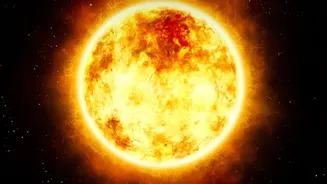
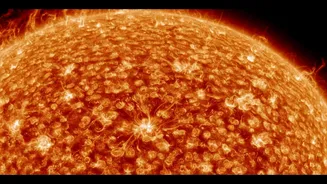
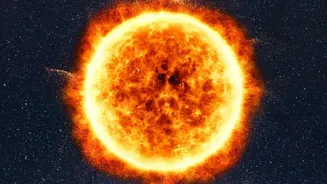
Scientists have captured the highest-resolution images ever taken of the sun's surface, providing a stunningly detailed look at our star. The images were taken by the National Science Foundation's Daniel K. Inouye Solar Telescope in Hawaii, the most powerful
solar telescope on Earth. While the headline mentions NASA, the key breakthrough comes from this ground-based observatory, in which NASA is a partner. These images reveal features as small as 20 kilometers across, a scale previously impossible to observe. What they show are turbulent, swirling vortices of plasma—superheated gas—that look like golden, breaking waves on the sun's surface. This provides a direct look at the engine driving the sun's complex behavior.
The Sun's Feverish Crown
For decades, solar physicists have been stumped by the coronal heating problem. The sun's visible surface, or photosphere, simmers at about 5,500 degrees Celsius. Yet the corona, the tenuous atmosphere stretching millions of kilometers into space, reaches a staggering one million degrees or more. According to the laws of thermodynamics, heat shouldn't flow from a cooler object to a hotter one, so some other mechanism must be pumping enormous amounts of energy from the sun's interior into its atmosphere. Identifying this mechanism has been a primary goal of solar science.
Seeing the Swirls
The new images provide the first direct confirmation of a long-hypothesized process on the sun's surface called the Kelvin-Helmholtz instability (KHI). This instability occurs when two fluids, or in this case plasmas, slide past each other at different speeds, creating a shear that whips up small disturbances into spiraling vortices. We see this same effect in swirling clouds on Earth and in the cloud bands of Jupiter. On the sun, these tiny whirlpools, previously only theorized, are now seen churning at the edges of solar granules—the Texas-sized cells of boiling plasma that cover the sun's face.
Braiding Magnetic Fields
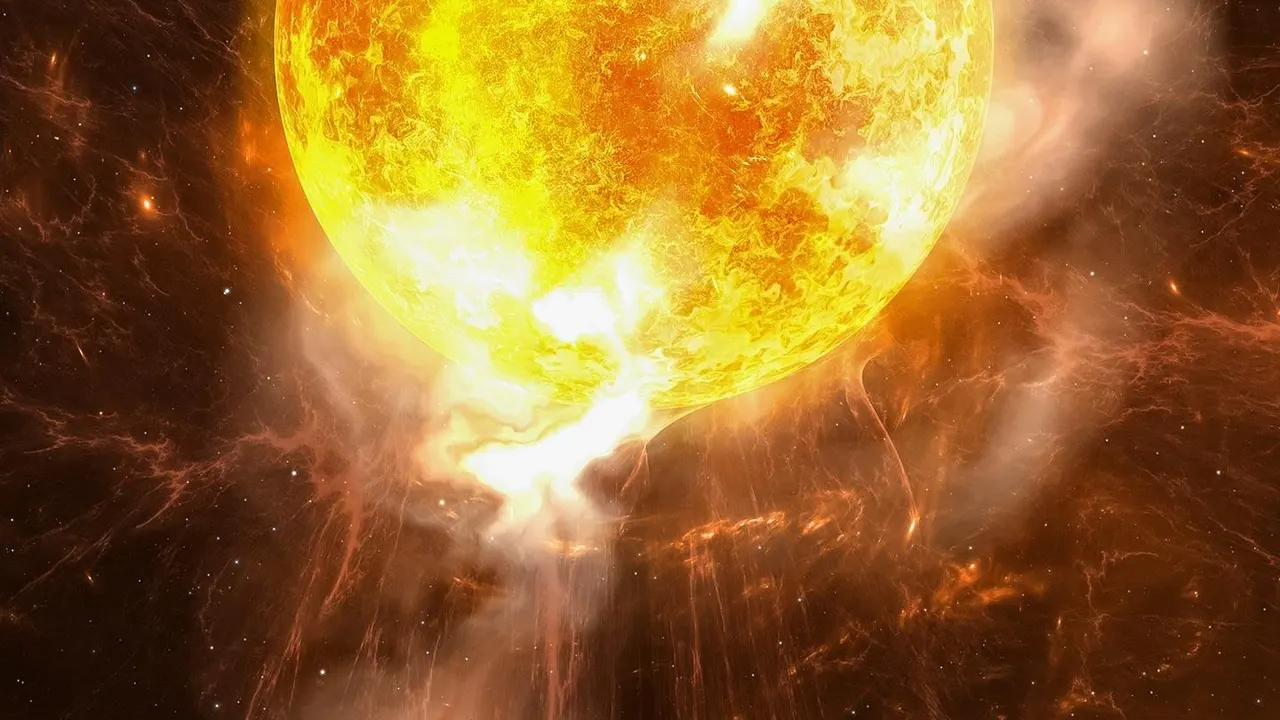
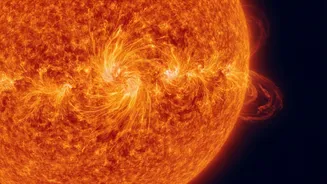
So how do these tiny swirls heat an entire atmosphere? The answer lies in the sun's powerful magnetic fields. Astronomers believe that the sun's magnetic field lines get twisted and braided together like hair by the constant motion of plasma on the surface. This braiding builds up tension. The KHI vortices seen in the new images are now considered a key culprit in starting this braiding process. Eventually, the tension becomes too great, and the magnetic field lines snap and reconnect, releasing their stored energy in explosive bursts. While we can see large-scale versions of this as solar flares, the theory suggests that countless tiny versions, called 'nanoflares', could be happening all the time, collectively providing enough energy to superheat the corona.
Why It Matters for Earth
Solving the coronal heating mystery isn't just an academic exercise. The same magnetic processes that heat the corona also drive space weather—the solar flares and coronal mass ejections that hurl radiation and plasma into the solar system. These events can disrupt satellites, endanger astronauts, and even knock out power grids on Earth. By understanding the fundamental physics of how energy is transferred and released from the sun, scientists can build better models to predict these powerful solar storms. These new images represent a major leap forward, transforming a theoretical process into something directly observable and giving us a new window into the workings of our star.