


A Cosmic Engine Hiding in Plain Sight
For years, the celestial source IRAS 18293-0941, located in the star-forming Serpens-Aquila region, has been an object of astronomical curiosity. Shrouded by dense clouds of gas and dust, its true nature was difficult to decipher. It appeared bright,
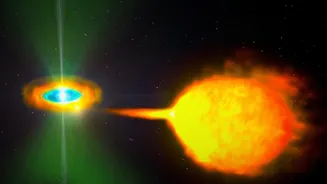
but what was powering it remained a mystery. Was it a young, energetic star? Or was it something far more exotic? Recent observations have peeled back the curtain, revealing evidence that points towards one of the most extreme objects in the universe: a stellar-mass black hole actively feeding on a companion star.
Blazars, But in Miniature
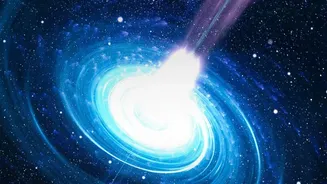
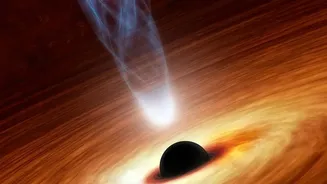
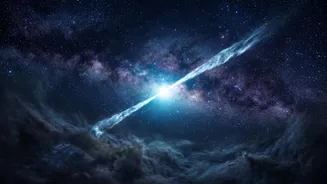
To understand what makes this discovery so exciting, we first need to talk about blazars. A blazar is a distant galaxy with a supermassive black hole at its centre—weighing millions or even billions of times more than our sun. As this behemoth pulls in surrounding matter, it shoots out colossal jets of plasma at nearly the speed of light. When one of these jets happens to be pointed directly at Earth, the object appears incredibly luminous. A microblazar is simply a miniature version of this phenomenon. Instead of a supermassive black hole, the engine is a stellar-mass black hole, just a few times the mass of the sun, located within our own Milky Way galaxy. The physics are similar, but the scale is vastly different.
The Smoking Gun: A Relativistic Jet
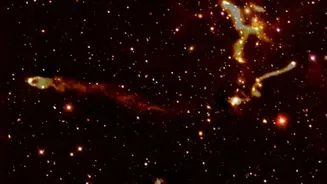
The crucial new evidence for IRAS 18293-0941 comes from detailed radio observations. Astronomers detected a stable, compact jet of material emanating from the object. The characteristics of this jet—its brightness, consistency, and inferred speed—are the telltale signs of an accreting black hole. While young stars can also produce outflows, they are typically slower, clunkier, and less focused. The jet from IRAS 18293-0941 is a powerful, persistent beam, a signature that strongly suggests it's being launched by the intense gravitational field of a compact object, with a stellar black hole being the most likely culprit.
A Black Hole in a Stellar Nursery
Perhaps the most fascinating aspect of this discovery is the object's location. Finding a potential black hole system inside a protostellar region—a cosmic cradle where new stars are born—is highly unusual. This raises a host of new questions. How did this black hole and its companion star end up in such a dense, chaotic environment? And what effect are its powerful jets having on the delicate process of star formation happening around it? These jets pump huge amounts of energy into the surrounding clouds, which could either trigger the collapse of gas to form new stars or blow the material away, preventing them from forming altogether. It's a case of cosmic creation and destruction happening side-by-side.
Why This One Object Matters
Microblazars are incredibly important tools for astrophysicists. Because they are in our galaxy, they are much closer than their supermassive cousins, allowing for more detailed study. They provide a unique laboratory to test our understanding of how black holes of all sizes create such powerful jets. Finding new candidates like IRAS 18293-0941 is critical, as these objects are rare due to the precise alignment needed for us to see them. This particular candidate, with its peculiar environment, promises to offer unique insights into the relationship between black holes and star formation, helping to complete a major piece of the cosmic puzzle.