


A Galaxy Out of Line
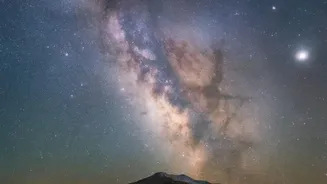
When we picture the Milky Way, we imagine a flat, spinning disc of stars, dust, and gas. For the most part, that's accurate. But astronomers have long been puzzled by its orientation. Our galaxy is part of a much larger structure known as the Local Sheet,
a flattened collection of galaxies millions of light-years across. Most galaxies within this sheet are aligned, moving in a cohesive way, but the Milky Way is an outlier, tilted at a peculiar angle relative to its neighbors. New research presented at the 2026 National Astronomy Meeting suggests this isn't a random quirk of nature but the scar of a cataclysmic event from our galaxy’s youth.
The Prime Suspect: A Head-On Collision
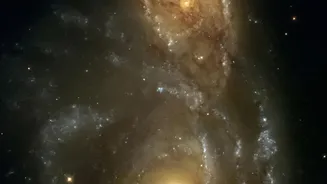
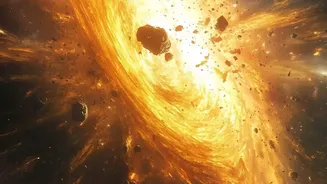
The culprit appears to be a major galactic merger that occurred around 10 to 11 billion years ago. Researchers from Durham University used powerful supercomputer simulations to model the evolution of galaxies like ours. They found that a massive, head-on collision with a dwarf galaxy could explain the Milky Way's current state. This specific crash involved a galaxy astronomers have nicknamed the 'Gaia-Sausage-Enceladus', so-called because its stars were stretched into elongated, sausage-like orbits after the impact. This event is considered the last major merger in our galaxy's history and fundamentally reshaped it.
A Galactic Disc Flip
According to the simulations, the force of this collision was so immense that it likely caused the entire disc of the Milky Way to slowly reorient itself over hundreds of millions of years. This process, known as a 'disc flip', would have tilted the galaxy by more than 90 degrees. Imagine a spinning frisbee being struck on its edge and gradually tipping over onto its side—that's essentially what may have happened to our home galaxy. This theory solves a long-standing astronomical mystery: why the Milky Way's stellar halo—a sparse, spherical cloud of ancient stars surrounding the main disc—rotates so slowly. The simulations showed that galaxies that undergo a major merger and a disc flip almost always end up with a slowly rotating halo, just like ours.
Uncovering the Cosmic Crime Scene
Astronomers can't travel back in time to witness this event, so they rely on digital forensics. By analyzing data from the European Space Agency's Gaia mission, which has mapped the positions and motions of billions of stars, they identified the strange, slow rotation of the stellar halo. The supercomputer simulations, part of the Auriga Project, allowed researchers to test different scenarios and found a direct link between a Gaia-Sausage-like merger, a subsequent disc flip, and a slow-moving halo. Independent research from the Chinese Academy of Sciences supports this, finding that the Milky Way’s vast dark matter halo appears to be oriented almost perpendicular to the stellar disc—another tell-tale sign of a past flip.
A New Chapter in Our Cosmic History
This discovery does more than just solve a puzzle; it rewrites a key chapter of our galaxy's biography. It implies that the path of every star, including our own Sun, may have once been drastically different. This finding reinforces our understanding of the universe as a dynamic and often violent place, where the structures we see today were forged in chaotic collisions. Our galaxy is not an isolated island but a product of its turbulent environment. While the Gaia-Sausage collision was the last major impact, the Milky Way continues to interact with smaller galaxies and is on a collision course with its much larger neighbor, Andromeda, though that encounter is still about 4.5 billion years away.