


An Unimaginable Velocity
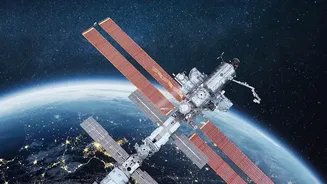
To circle the Earth in the time it takes to watch a movie, the ISS maintains a staggering speed of roughly 28,000 kilometres per hour (about 17,500 mph). That’s more than 20 times the speed of sound. At this velocity, the station travels a distance equivalent
to going from Earth to the Moon and back in a single day. It orbits at an altitude of about 400 kilometres (250 miles) in what is known as low Earth orbit. This specific altitude is a carefully chosen compromise: high enough to avoid significant atmospheric drag but low enough to make resupply missions from Earth feasible and to stay clear of the more intense radiation in the Van Allen belts.
The Science of Staying in Orbit
What keeps this football-field-sized object from either flying off into deep space or crashing back to Earth? The answer is a delicate dance between speed and gravity. The station is in a constant state of freefall. Gravity pulls it towards our planet, but its immense forward velocity means that as it falls, the Earth's surface curves away from it at the same rate. This continuous 'fall' creates a stable orbit. However, even at 400 kilometres up, there are still traces of Earth's atmosphere that create drag, slowly pulling the station down. To counteract this, the ISS requires periodic 'reboosts'—thruster firings from visiting spacecraft or its own systems to push it back up to its optimal altitude.
A Day of 16 Sunrises
For the crew, this rapid orbit means they witness about 16 sunrises and 16 sunsets every 24 hours. A new day or night streaks past the windows approximately every 45 minutes. While visually spectacular, this could wreak havoc on the human body's internal clock, or circadian rhythm, which is tuned to a 24-hour cycle. To manage this, life on the ISS runs on a strict 24-hour schedule based on Coordinated Universal Time (UTC). The station's internal lighting system is programmed to simulate a normal day-night cycle, helping astronauts regulate their sleep and work patterns despite the constant changes outside.
The Best View in the Solar System
Many astronauts describe the view of Earth as the most profound part of their mission, an experience often called the 'Overview Effect'. The best seat in the house is the Cupola, a seven-windowed dome on the Earth-facing side of the station. From this vantage point, crew members can watch continents glide by, lightning storms flash silently over the oceans, and the brilliant green and purple ribbons of the aurora dance over the poles. The 90-minute orbit provides a constantly changing tapestry of the planet. In less than an hour, an astronaut can see the deserts of Africa, the snow-capped Himalayas, and the sprawling lights of Europe at night.
A Platform for Global Science
The station's high-speed, globe-spanning orbit isn't just for sightseeing. It makes the ISS an unparalleled platform for scientific research. Its path takes it over 90% of the world's populated areas, allowing for comprehensive Earth observation, from tracking weather patterns and natural disasters to monitoring deforestation and pollution. As a laboratory in microgravity, it has hosted thousands of experiments from over 100 countries, advancing our understanding of biology, physics, and medicine. This continuous human presence in space, a collaboration between five international space agencies, serves as a crucial testbed for the technologies needed for future missions to the Moon and Mars.