








A Body Not Built for Deep Space
For decades, we’ve known that space is tough on the human body. Astronauts on the International Space Station (ISS) experience muscle atrophy, bone density loss, and vision changes. But the ISS orbits within the relative safety of Earth's magnetic field,
which shields it from the worst of cosmic radiation. True deep space, the vast expanse between planets, is an entirely different and more dangerous environment. On a long-duration mission to the Moon or Mars, astronauts would be exposed to a constant barrage of galactic cosmic rays—high-energy particles that can slice through spacecraft and human DNA. This radiation dramatically increases the risk for cancer, cardiovascular disease, and central nervous system damage. Before we can send people on multi-year journeys, we must first understand precisely how this environment harms the body and, more importantly, how to stop it.
What Are These Mini-Models?
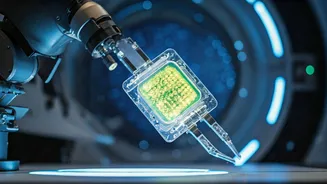
The “mini human-tissue models” at the heart of this research are marvels of biomedical engineering called “organ-on-a-chip” or “tissue chips.” Forget tiny, scaled-down organs; these are transparent, flexible devices, often about the size of a USB thumb drive, containing microscopic channels lined with living human cells. A sophisticated system of pumps delivers nutrients and removes waste, creating a micro-environment that mimics the function of a specific human organ, like bone marrow, a lung, or heart tissue. This technology allows scientists to watch in real-time how human tissue responds to stress, drugs, and environmental changes. Because microgravity makes cells behave more like they do inside the body, space provides a uniquely powerful laboratory for this work. The accelerated aging-like effects observed in space mean scientists can study disease progression in weeks, a process that might take years on Earth.
The Artemis II 'AVATAR' Mission
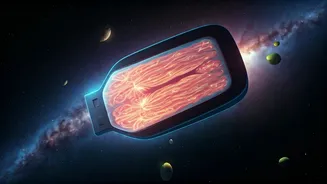
The headline-making experiment flew aboard NASA’s recent Artemis II mission, which took four astronauts on a trip around the Moon. Dubbed AVATAR, short for A Virtual Astronaut Tissue Analog Response, this project represents a groundbreaking new phase of research. For the first time, the tissue chips sent into deep space were personalized. Scientists took cells from the Artemis II astronauts themselves to grow bone marrow on the chips. These cellular “avatars” flew alongside the crew, housed in a small, automated life-support system inside the Orion capsule. One batch of identical chips remained on Earth as a perfect control group. By flying outside Earth's protective magnetic shield, these avatars were exposed to the same deep space radiation and microgravity as the crew, giving scientists an unprecedented parallel look at the damage on a cellular level. Bone marrow was chosen specifically because it is highly sensitive to radiation and is the factory for our immune system.
From Space Science to Earth Medicine
The primary goal of the AVATAR experiment is to develop countermeasures—from targeted drugs to better shielding—to protect the health of future deep space explorers. By comparing the space-flown chips to the ground-based ones and to blood samples from the astronauts, researchers can pinpoint the exact effects of the journey and test potential therapies. But the benefits of this research extend far beyond NASA. By studying how radiation damages bone marrow, scientists can gain new insights into improving radiation therapy for cancer patients on Earth. The ability to model accelerated disease processes on a chip could revolutionize drug development, making it faster, cheaper, and more accurate. This work could lead to breakthroughs in treatments for osteoporosis, muscle wasting, and other age-related illnesses that affect millions worldwide.