





Why Control Is King
Swinging, bouncing, or kipping your way through ring dips might help you log more reps, but it comes at a cost. Using momentum bypasses the very muscles you’re trying to strengthen and places significant stress on your shoulder joints, which can lead
to injury. True gymnastic strength is built through deliberate, controlled movement. By slowing down and eliminating momentum, you force your chest, triceps, and shoulders to do all the work. This creates greater mechanical tension, which is the primary driver for both muscle growth and strength adaptation. Each controlled repetition is more valuable than several sloppy ones, building a resilient and powerful upper body.
Start with the Support Hold
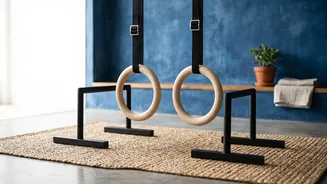
Before you can dip, you must be able to hold. The top of the ring dip, known as the support hold, is a foundational position that builds essential stability. Get into position with your arms fully locked out and straight. A critical cue here is to turn the rings out, so your palms face forward. This action, known as Ring Turn Out (RTO), externally rotates your shoulders, creating a much more stable and powerful pressing position. While holding, focus on keeping your shoulders depressed, meaning pulled down and away from your ears. Avoid shrugging or letting your shoulders dump forward. Practice holding this solid position for sets of 20–30 seconds to build the initial stability required for the full movement.
Master the Negative Rep
The secret to building the strength for a full dip lies in the negative, or eccentric, portion of the movement. You are significantly stronger when lowering your body than when pushing it up. By focusing on a slow and controlled descent, you can build strength through the full range of motion. Start in the top support hold position. From there, lower yourself as slowly as possible, aiming for a 5- to 10-second descent. Keep the rings close to your body and maintain a slight forward lean. Go as deep as your mobility allows without pain, ideally until your shoulders are slightly below your elbows. At the bottom, you can place your feet on the ground and then reset for the next rep. Performing sets of 3-5 slow negatives is one of the most effective ways to progress.
Use Smart Assistance
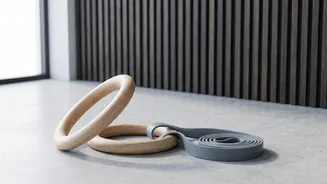
Assistance exercises help you learn the proper movement pattern without sacrificing form. Using a resistance band is a popular option. Loop a band over both rings and place your knees or feet in it. The band will provide the most help at the bottom of the dip, which is the hardest part of the movement. Another excellent method is the leg-assisted dip. Set the rings low enough that you can place your feet on the floor or a box in front of you. Use your legs to provide just enough assistance to push yourself up with good form, then try to control the negative portion without leg help. This allows you to train the full range of motion and progressively decrease your reliance on assistance as you get stronger.
Perfect Form for a Full Rep
Once you have built a solid foundation, you can start putting it all together for a full, controlled ring dip. Begin in your strong support hold with rings turned out. Initiate the movement by leaning forward slightly and bending your elbows, keeping them tucked close to your body. Control your descent all the way to the bottom position. Pause for a moment to kill any momentum. From the bottom, drive forcefully back up, squeezing your chest and triceps. As you approach the top, think about pushing down and turning the rings out to return to that stable, locked-out support hold. The goal is to make the movement look and feel smooth, with no shaking or bouncing. Stop your set as soon as your form begins to break down; quality over quantity is the rule.