

A Cosmic Trio in the Early Universe
Astronomers pointed the powerful eye of the James Webb Space Telescope (JWST) at a distant galaxy cataloged as J0148-4214. Its light has traveled for over 12.5 billion years to reach us, meaning we are seeing this galaxy as it was just 1.2 billion years after
the Big Bang. Initially, scientists were hoping to find pairs of black holes, but what they uncovered was even more remarkable: the first evidence of three actively feeding supermassive black holes within a single galaxy in the early universe. This discovery provides a rare, direct look at the chaotic processes that shaped the cosmos in its infancy.
Hunting Black Holes With Light
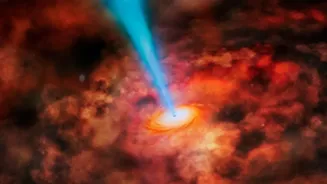
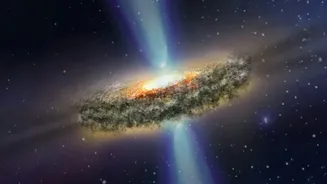
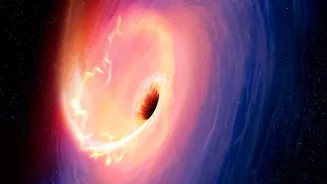
You can't see a black hole directly, as its gravity is so immense that not even light can escape. So how do you find one? Astronomers look for the tell-tale signs of its influence. These three are all "active" black holes, meaning they are surrounded by a swirling disk of gas and dust called an accretion disk. As this material spirals into the black hole, it's heated to extreme temperatures and glows intensely. It's this light from the material around the black hole that Webb can detect. In this case, the team specifically looked for the signature of fast-moving hydrogen gas, which is a key indicator of a supermassive black hole's presence.
Webb’s Secret Weapon: The NIRSpec Instrument
The discovery was made possible by one of Webb's key instruments, the Near-Infrared Spectrograph, or NIRSpec. Think of NIRSpec as a cosmic prism. It takes the light from a celestial object and splits it into its component colors, or spectrum. Within this spectrum, astronomers can read signatures, or emission lines, of different elements. For J0148-4214, the team used NIRSpec’s Integral Field Unit, which allowed them to capture a spectrum for every single pixel of the galaxy image. This is like being able to dissect the galaxy's light piece by piece, rather than just seeing one big, blurry average. Without this capability, the multiple black holes would have blended together into what looked like a single object.
The Hydrogen Fingerprint
The specific clue that gave away the black holes was found in the light from hydrogen atoms. When gas is swirling violently in the immense gravitational field of a black hole, the hydrogen emission lines in its spectrum become very broad. The NIRSpec data from J0148-4214 revealed three distinct regions, each with its own broad hydrogen signature, confirming the presence of three separate, actively accreting black holes. Two of the black holes are huddled close together near the galaxy's center, only about 620 light-years apart, while a third is located further out, about 5,500 light-years away.
Why This Discovery Matters
Finding this black hole trio rewrites a key chapter in the story of cosmic evolution. One of the biggest puzzles in astronomy is how supermassive black holes grew so massive, so quickly in the early universe. This discovery strongly suggests that galactic mergers were a primary driver. As smaller galaxies collided and merged, their central black holes would have been brought closer together, eventually merging themselves to form even larger behemoths. J0148-4214 is a snapshot of this process in action. The two central black holes are expected to merge in a few hundred million years, an event that future gravitational wave observatories might be able to detect. This system shows that the early universe was efficient at assembling these cosmic monsters, setting the stage for the giant galaxies we see today.