

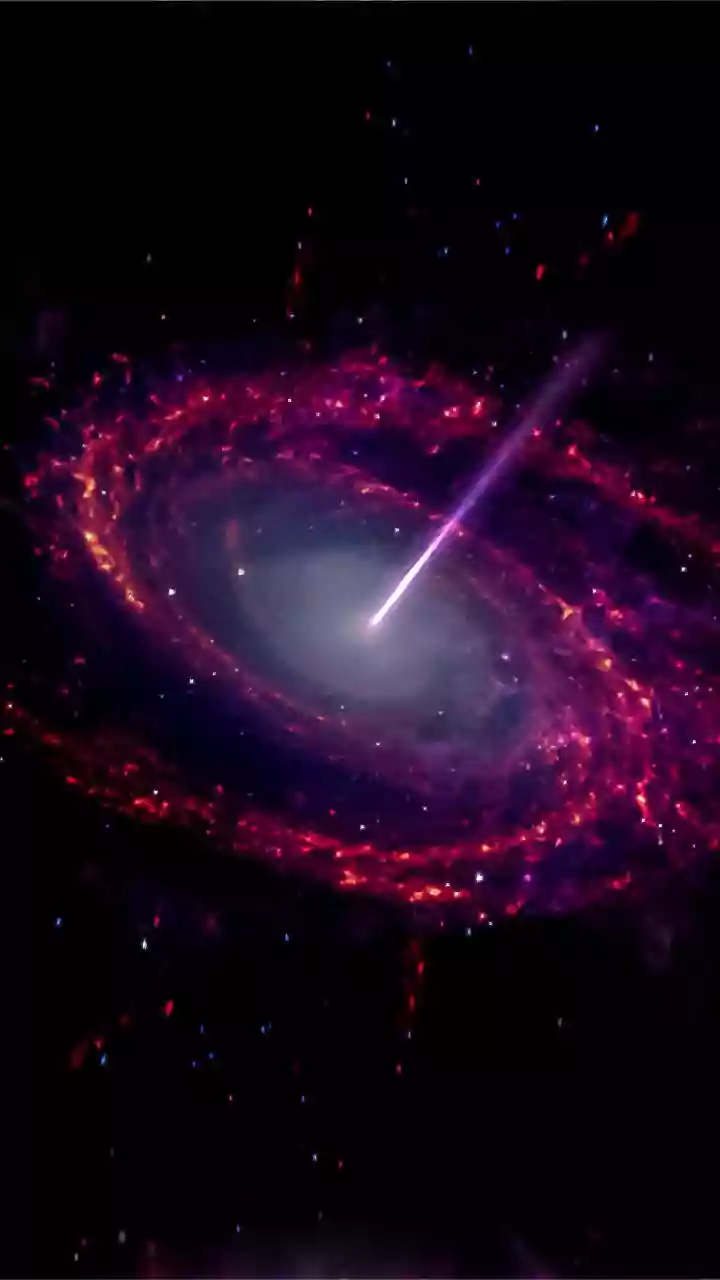



Our Cosmic Next-Door Neighbor
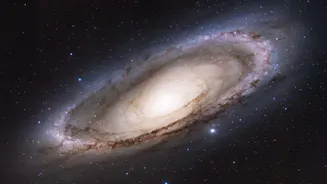
The Andromeda galaxy, also known as M31, is the closest major galaxy to our own Milky Way. Located about 2.5 million light-years away, it’s so close that you can see it with the naked eye from a dark-sky location as a faint, fuzzy smudge. This proximity
makes it a perfect laboratory for understanding how large spiral galaxies like our own form and evolve. Because we are inside the Milky Way, it’s difficult to get a complete picture of our galaxy's structure and history. Studying Andromeda is like having a sibling to compare ourselves to, offering crucial outside perspective on the story of galactic life.
A Telescope That Sees Through Time
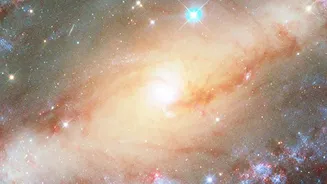
To read Andromeda's history, astronomers turned to the Hubble Space Telescope. Over more than a decade, Hubble conducted massive surveys, primarily the Panchromatic Hubble Andromeda Treasury (PHAT) and the Panchromatic Hubble Andromeda Southern Treasury (PHAST). These projects painstakingly mapped about two-thirds of the galaxy's sprawling disk, capturing images across ultraviolet, visible, and near-infrared light. The result was a gigantic mosaic resolving over 200 million individual stars. This incredible detail acts as a galactic fossil record. As one astronomer on the study noted, Hubble is the only telescope with high enough resolution over a wide enough area to make this kind of detailed analysis of Andromeda possible.
From Starlight to Star Births
So, how do you tell a star's age from millions of light-years away? The secret is in its color and brightness. Massive, young stars burn hot and fast, giving off a brilliant blue light, but they have short lives. Less massive, older stars are cooler, live much longer, and glow with a reddish hue. By analyzing the light from hundreds of millions of stars, scientists could sort them into different age groups. They divided the vast image of Andromeda into thousands of smaller sections and calculated the star formation history within each one, piecing together a comprehensive timeline of the galaxy's recent past.
A Galaxy Winding Down
The study revealed a fascinating story of change. While Andromeda experienced a massive burst of star birth about two billion years ago, likely from a collision with another galaxy, its more recent history is one of steady decline. The new data shows that over the last 500 million years, the galaxy's star formation rate has been winding down. Around 500 million years ago, it was producing stars at a rate of about one solar mass per year. That rate has since dropped significantly, with an even steeper decline in the last 40 million years. Today, its output is only about one-fifth of a solar mass per year, suggesting the galaxy is transitioning from an active hub of creation into a more quiescent, or quiet, state.
A Tale of Two Galaxies
This history of boom and bust sets Andromeda apart from our own galaxy. The Milky Way is believed to have a more consistent and steady rate of star formation. Andromeda, on the other hand, seems to have a more violent and active past, with big events triggering bursts of activity followed by long, quiet periods. Much of Andromeda's recent star-making has been concentrated in a prominent ring about 32,000 light-years from its center, and it is this ring that is now fading. Astronomers also suspect that interactions with its small satellite galaxy, M32, may have played a role in disrupting gas clouds and creating 'dead zones' where star birth has ceased.