






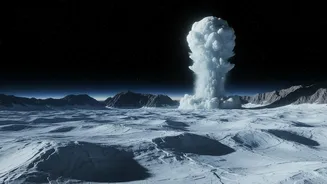
A World of Surprising Activity
For decades, Pluto was just a faint speck of light in our most powerful telescopes. But the 2015 flyby transformed our understanding, painting a portrait of a dynamic dwarf planet with vast nitrogen glaciers, towering mountains of water ice, and a surprisingly
complex atmosphere. The most iconic feature is Tombaugh Regio, the bright, heart-shaped plain. The western lobe of this heart, a huge basin called Sputnik Planitia, is filled with frozen nitrogen. But contrasting with this brightness are dark, reddish-brown regions, most notably a huge belt near the equator called Cthulhu Macula, that have puzzled scientists. These features suggested that Pluto was not a simple, inert ball of ice and rock.
The Mystery of the Dark Features
The large, dark equatorial patches like Cthulhu Macula are thought to get their colour from complex organic compounds called tholins. These reddish molecules are created when ultraviolet light from the sun or cosmic rays interact with methane in Pluto’s atmosphere and on its surface, causing them to rain down and stain the landscape. However, recent studies based on New Horizons data have focused on a different kind of dark feature: streaks and patches found along the edges of the polygonal convection cells within the bright Sputnik Planitia glacier. These features look similar to patterns on Earth's own ice sheets where meltwater has darkened the surface. But with surface temperatures hovering around a frigid minus 220 degrees Celsius, conventional melting seemed impossible.
A New Liquid Nitrogen Theory
This is where a fascinating new theory comes in. A recent analysis of New Horizons imagery suggests these dark streaks may be the first evidence of recently flowing liquid on Pluto's surface. The liquid in question is not water, but nitrogen. Scientists propose that liquid nitrogen may be seeping up from beneath the Sputnik Planitia glacier. Given Pluto's extremely low atmospheric pressure—roughly 1/100,000th of Earth's—liquid nitrogen cannot last on the surface for long before it turns directly into gas. Therefore, the theory doesn't involve permanent rivers, but rather transient flows that occasionally well up from below.
How Could Liquid Exist?
The idea hinges on what’s happening deep beneath the ice. Sputnik Planitia is a glacier several kilometres deep. Computer models suggest that while the surface is incredibly cold, heat from Pluto’s rocky core could be just enough to melt the nitrogen ice at the very base of the glacier. This liquid nitrogen, being less dense than the solid ice above it, would then be buoyant. It could collect in reservoirs before rising up through cracks and fractures in the ice, similar to how magma moves through volcanic systems on Earth. When it reaches the surface, it would briefly flow, wetting the ground and darkening the nitrogen ice before freezing or sublimating. This process would explain the dark, narrow streaks seen at the boundaries of the ice cells.
An Ever-Changing World
If this hypothesis holds true, it would mean Pluto is more geologically active in the present day than previously thought. The surface of Sputnik Planitia is already considered quite young in geological terms—likely less than a million years old—because of the constant churning of its convection cells. The presence of recent liquid flows adds another layer of dynamic activity. “Pluto never stops surprising us,” said Alan Stern, the principal investigator for the New Horizons mission. This finding suggests a new kind of time-variable feature on the dwarf planet, hinting that its surface may be subtly changing even now. Similar processes could even be at work on other distant, icy bodies in our solar system, such as Neptune's moon Triton.