



A Star System Like No Other
The Beta Pictoris system is something of a celebrity in the astronomical community. Located just 63 light-years from Earth, it is incredibly young in cosmic terms, at only about 23 million years old. This youth makes it a perfect laboratory for studying
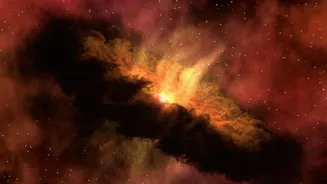
how planetary systems form and evolve. For decades, scientists have observed its massive, bright disk of dust and debris—the raw material for making planets. Before this new discovery, astronomers already knew of two massive gas giants orbiting the star: Beta Pictoris b and c. Beta Pictoris b was one of the very first exoplanets to be directly photographed, making the system a cornerstone of planet-hunting science. Because it is so well-studied, nobody was expecting another major player to be lurking in the wings.
An Unexpected Signal
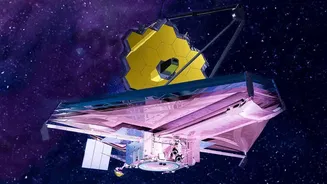
The discovery of the new planet, now named Beta Pictoris d, was a complete surprise. A team of astronomers was using the James Webb Space Telescope (JWST) to study the atmosphere of the already-known planet, Beta Pictoris b. They weren't searching for a new world. But as they analyzed the data, a faint, unexpected signal appeared in a different location. “We weren’t looking for a new planet,” said Aidan Gibbs, the lead author of the study. “Then, this telltale signal appeared in the data where we didn’t expect it.” This serendipitous discovery highlights the power of modern telescopes, which are so sensitive that they can uncover secrets even when scientists are not actively looking for them.
A New Way to Find Hidden Worlds
What makes the JWST’s discovery so groundbreaking is how it found Beta Pictoris d. The system is shrouded in a thick disk of dusty debris that acts like a cosmic fog, making it difficult to spot the faint light of a planet directly. Instead of trying to see the planet as a point of light, Webb used its powerful NIRSpec instrument to analyze the light from the region. It detected the unmistakable chemical fingerprint of a planetary atmosphere, identifying molecules like methane and carbon monoxide. This spectroscopic method essentially allowed astronomers to ignore the dusty haze and confirm the presence of a planet by its chemical composition alone. It's a powerful new technique that could transform the search for other exoplanets that have been hidden from view.
Hiding in Plain Sight for Years
In a remarkable coincidence, just as the JWST team was making its discovery, an independent team of astronomers found the same planet using the European Southern Observatory's Very Large Telescope (VLT) in Chile. This second team used a more traditional direct imaging approach but with new, highly sensitive instruments. Their confirmation prompted them to look back at archival data from the past 11 years. To their astonishment, they realised the planet had been there all along, a faint speck hiding in old images, previously dismissed as noise. Beta Pictoris d, it seems, has been playing a decade-long game of hide-and-seek with astronomers and has only just been caught.
Solving an Old Mystery
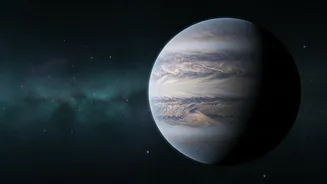
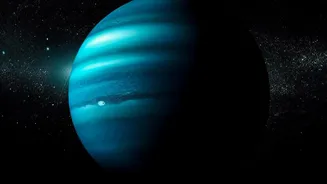
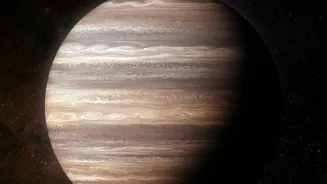
The discovery of Beta Pictoris d does more than just add a new member to this stellar family. It also helps solve a long-standing puzzle. The system's vast debris disk has a curiously sharp inner edge and other strange structures that scientists have struggled to explain. The presence of Beta Pictoris d, a gas giant estimated to be about two times the mass of Jupiter, in its specific orbit could be the gravitational force needed to 'sculpt' the disk into its observed shape. Discovering multiple-planet systems like this is considered a 'holy grail' for astronomers, as it allows them to compare different planets that formed in the same environment, offering deep insights into the story of planetary creation.