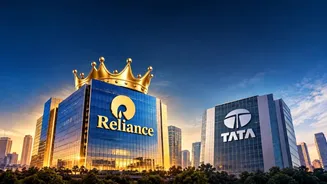





A tectonic shift has occurred at the summit of Indian business. The Reliance Group has overtaken the long-reigning Tata Group as the country's most valuable conglomerate, measured by the combined market capitalisation of their listed companies.
A New Leader Emerges
In a historic
changing of the guard, the Mukesh Ambani-led Reliance Group has ascended to the top of India’s corporate hierarchy. As of late October 2026, the combined market valuation of Reliance's listed entities surged to approximately ₹30 lakh crore. This pushed it past the Tata Group, whose listed firms commanded a total market capitalisation of around ₹25.3 lakh crore. The move marks a significant moment, displacing a conglomerate that has been the standard-bearer of Indian industry for decades. The shift is not just a numerical adjustment on the stock exchange but a powerful symbol of the changing economic forces shaping the nation.
The Jio Juggernaut
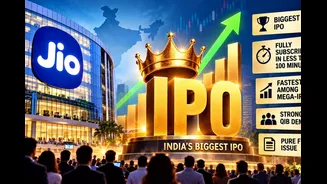
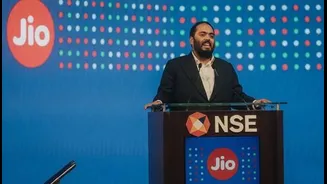
The primary catalyst for this dramatic reordering was the blockbuster stock market debut of Jio Platforms. The digital and telecom arm of Reliance made a spectacular entrance, with its shares surging over 26% on its listing day. This performance instantly created a corporate giant with a market capitalisation of ₹13 lakh crore, making it India's second-most valuable company, trailing only its parent, Reliance Industries. The successful listing of Jio Platforms, following India's largest-ever IPO which raised over ₹30,000 crore, added immense value to the Reliance Group's portfolio. This single event effectively tipped the scales, combining with the value of Reliance Industries (around ₹15.7 lakh crore) and Jio Financial Services (around ₹1.35 lakh crore) to create an unassailable lead.
The Tata Perspective
While Reliance's rapid ascent is the story of the moment, the Tata Group remains a formidable force in Indian business. With a legacy stretching back to 1868, the group consists of over 18 listed companies, including titans like Tata Consultancy Services (TCS), Tata Motors, Tata Steel, and Titan. The group's combined valuation of over ₹25 lakh crore underscores its vast and diversified presence across nearly every major sector, from technology and automotive to consumer goods and hospitality. The current change in ranking is less about a decline for Tata and more about the explosive, concentrated growth of Reliance's new-age, consumer-facing digital businesses. The Tata Group itself is in the midst of a strategic transformation, focusing on future-forward sectors like electric vehicles, electronics manufacturing, and digital platforms with its 'super-app' Tata Neu.
A Tale of Two Strategies
The shift in leadership highlights two divergent, yet successful, conglomerate strategies. Reliance's growth has been defined by aggressive, large_scale disruption in high_growth sectors. It first transformed the energy and petrochemicals landscape and then repeated the feat in telecommunications and retail, building dominant market positions with massive capital investment. Its focus is on creating new ecosystems and capturing the Indian consumer at scale. In contrast, the Tata Group's strength lies in its diversification and a portfolio of established, trusted brands. While some of its core businesses are in traditional industries, its IT services powerhouse, TCS, has been a consistent global leader for years. Its strategy has historically been one of steady, broad_based growth and global acquisitions, such as Jaguar Land Rover, which have expanded its international footprint.
What This Means for India Inc.
Reliance's rise to the top is more than a corporate horse race; it reflects a broader economic pivot towards digitalisation and consumer_centric services. The sheer valuation commanded by Jio Platforms underscores investor confidence in India's digital economy as the primary engine of future growth. For decades, industrial manufacturing and legacy services formed the bedrock of India's largest business houses. Now, platforms that control data, content, and consumer access are generating unprecedented wealth and market influence. This milestone signals that the path to market leadership in the new India runs directly through technology and the country’s billion_plus consumers. The ongoing rivalry between these two giants will likely define the next chapter of Indian capitalism, shaping innovation, investment, and competition for years to come.