


A Cosmic First in the Early Universe
Astronomers have announced the first-ever discovery of three actively feeding supermassive black holes within a single galaxy in the distant universe. The galaxy, designated J0148-4214, is so far away that its light has traveled for over 12.5 billion
years to reach us. This means we are seeing it as it existed just 1.2 billion years after the Big Bang, offering an unprecedented snapshot of a chaotic and formative period in cosmic history. The discovery, made by an international team using the Webb telescope's powerful NIRSpec instrument, wasn't a direct image of the black holes themselves, but an analysis of the light from the gas swirling around them.
Decoding the Broad-Line Region
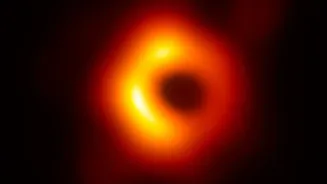
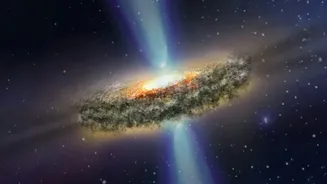
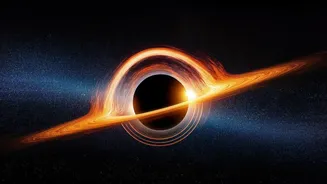
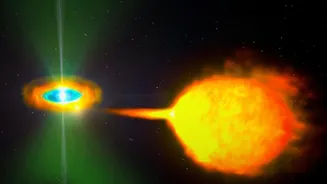
The key to this discovery lies in what astronomers call a 'broad-line region,' or BLR. Every supermassive black hole at the center of an active galaxy is surrounded by a disk of gas and dust that it feeds on. The gas clouds closest to the black hole move at incredibly high speeds due to the immense gravitational pull, causing the light they emit to be smeared out across a wide range of frequencies—a phenomenon known as Doppler broadening. This creates a specific signature in the galaxy's spectrum called a broad emission line. Finding one BLR signifies one active black hole. The Webb data, however, revealed the distinct signatures of three separate BLRs within J0148-4214, each indicating its own feeding, massive black hole.
A Trio of Giants
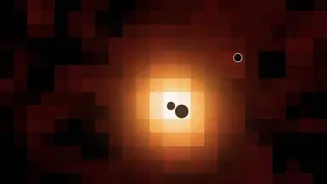
The arrangement of this cosmic trio is particularly compelling. Two of the black holes are located surprisingly close to each other in the galaxy's center, separated by a mere 620 light-years. A third black hole resides further out, about 5,500 light-years from the central pair. Their masses are as varied as their locations. The primary black hole is estimated to be around 80 million times the mass of our sun, while its close companion is a relatively tiny 600,000 solar masses, and the third weighs in at about 2 million solar masses. This intricate system suggests a galaxy in the midst of a violent and complex merger, a process thought to be fundamental to how galaxies and their central black holes grow.
Rewriting the Story of Black Hole Growth
This finding provides crucial evidence for one of the leading theories explaining a major astronomical puzzle: how did supermassive black holes get so enormous, so quickly in the early universe? While they can grow by accreting gas, that process alone may not be fast enough. This discovery offers a vivid look at another pathway: galactic mergers. When galaxies collide, their central black holes are drawn together. The system in J0148-4214 suggests that these mergers were not only common but could be incredibly crowded, leading to a rapid succession of black hole mergers that would bulk them up in a relatively short amount of cosmic time. Scientists estimate the two central black holes will likely merge in a few hundred million years, an event that future gravitational wave observatories might be able to detect from similar systems.