




The Ghost Particle Mystery
Neutrinos are fundamental particles, often called 'ghost particles' because they barely interact with other matter. Billions of them from the Sun pass through your body every second without you noticing. While we understand the source of lower-energy
neutrinos, the origins of their high-energy cosmic counterparts have remained one of the biggest puzzles in astrophysics. These particles are born in the most violent events in the universe, carrying immense energy across billions of light-years. Because they travel in straight lines, unaffected by magnetic fields, they point directly back to their source. The challenge is catching them. Deep under the Antarctic ice, the IceCube Neutrino Observatory uses a cubic kilometre of pristine ice as its detector, waiting for the faint flash of light that signals a rare neutrino interaction.
Inside the Cosmic Factories
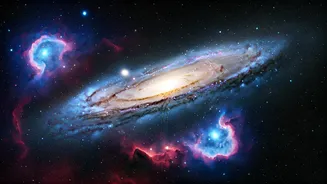
The headline's 'dusty star factories' refer to a class of galaxies known as starburst galaxies. These are not calm, quiet places like our own Milky Way. A starburst galaxy is a cosmic cauldron, forming new stars at a rate hundreds or even thousands of times faster than normal. This frantic pace of star birth and death creates an extremely turbulent environment, rich in gas and cosmic dust. This dust is so thick that it often hides the galaxy from view in visible light, making it appear dark. However, all the energy from the young, hot stars heats the dust, causing the galaxy to glow intensely in infrared light. Scientists have long suspected these extreme environments could be powerful enough to accelerate particles to incredible speeds, but direct evidence was missing.
A Clue from 11 Billion Years Ago
The latest breakthrough came from a single neutrino that arrived at IceCube on September 22, 2021. The alert sent astronomers scrambling to scan that patch of sky with telescopes across the globe. The search led them to a faint, distant object nicknamed the 'Shadow Blaster'. This object, formally known as JCMT0402-0424, is a dusty star-forming galaxy so far away that its light has taken 11 billion years to reach us. It is from an era of the universe called 'Cosmic Noon,' when star formation was at its peak. The galaxy was so shrouded in dust it was invisible to most telescopes. Astronomers could only spot it thanks to a cosmic coincidence: its light was magnified by the gravity of a closer galaxy, an effect called gravitational lensing, which acted like a natural telescope.
Connecting the Cosmic Dots
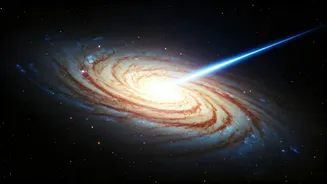
The theory is that in the chaotic core of a starburst galaxy, powerful shockwaves accelerate protons and other particles, creating cosmic rays. When these high-speed cosmic rays smash into the dense gas and dust, they produce a shower of secondary particles, including high-energy neutrinos. While this process also creates high-energy gamma rays, the thick dust clouds can absorb them, hiding them from view. Neutrinos, however, pass through the dust unimpeded, carrying a clear signal of the powerful engine at the galaxy's heart. The 'Shadow Blaster' fits this profile perfectly. Its position, extreme dustiness, and intense star-forming activity make it the most plausible source yet for this type of high-energy neutrino.
A New Window on the Universe
This discovery is a major step forward for multi-messenger astronomy, which combines signals from different cosmic 'messengers'—light, gravitational waves, and neutrinos—to build a complete picture of an event. While a chance alignment cannot be completely ruled out, the evidence is compelling. Scientists estimate that populations of these dusty starburst galaxies could be responsible for a significant fraction—perhaps up to 20%—of the total high-energy neutrino background seen across the universe. This finding doesn't solve the whole mystery, as other sources like active galactic nuclei are also confirmed neutrino producers. But it provides a crucial new piece of the puzzle, revealing that the universe's most powerful particle accelerators may be hiding in plain sight, concealed behind clouds of cosmic dust.