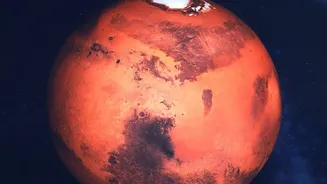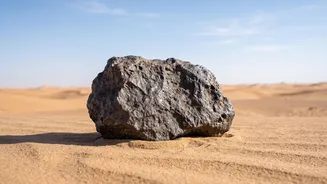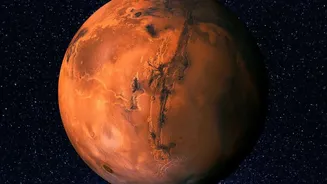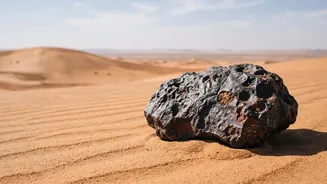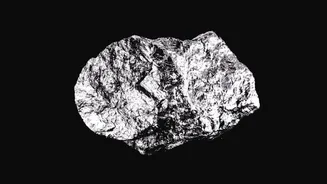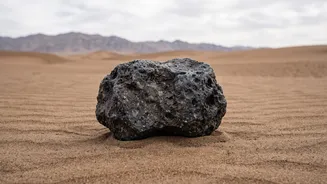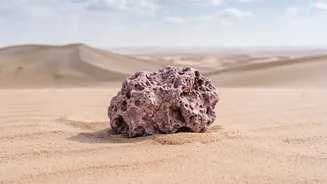




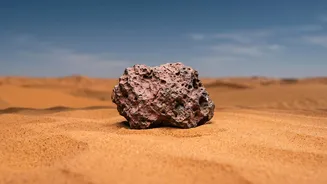
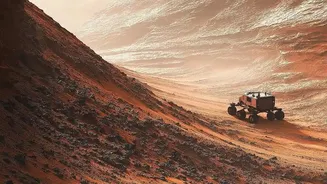
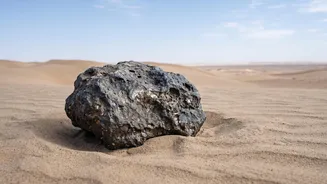
In 2022, meteorite hunters scouring a salt plain in Mali discovered a peculiar, rose-coloured rock. It would take dedicated analysis by scientists to reveal its true identity: a 4.1-billion-year-old piece of Mars, offering an unprecedented glimpse into
the planet’s infancy.
A Treasure in the Desert
The Sahara Desert is one of the world's great repositories of extraterrestrial visitors. Its dry, stable climate preserves meteorites that fall from the sky, protecting them from the weathering that would quickly destroy them in other environments. In 2022, a team of meteorite hunters came across a collection of eight fragments near a salt plain in Mali called Teghaza. The largest piece weighed under half a kilogram. Initially, the rock, officially named Teghaza 001, was thought to be a more common type of Martian meteorite. Its unassuming appearance, however, hid an extraordinary secret that would only be revealed once it was subjected to intense scientific scrutiny, years after it was picked from the sand.
Reading Time in a Crystal
Determining the age of a rock from another world is a meticulous process. For Teghaza 001, the key lay within tiny, incredibly resilient crystals called zircons embedded in the rock. Scientists describe zircons as 'time capsules' because as they form, they trap radioactive elements that decay at a predictable rate. By measuring the products of this decay, researchers can calculate a precise formation age. A team of NASA-funded scientists used this technique to date the zircons within Teghaza 001. The result was astonishing: the rock had formed at least 4.1 billion years ago, within the first 400 million years of Mars's existence, making it one of the three oldest Martian meteorites ever found on Earth.
Clues of an Ancient Watery World
Perhaps the most significant discovery from Teghaza 001 is the compelling evidence that it was altered by water. Its unique mineral composition and chemical signatures show that it interacted with water on Mars around the same time it formed. This finding provides a powerful data point suggesting that water was present and active on the Red Planet far earlier than many previous models indicated. It supports a picture of a primordial Mars that was much more dynamic, with a water cycle that could shape its crust. This meteorite effectively acts as a physical sample of a time when Mars may have had the necessary ingredients for habitability, helping scientists understand why it eventually became the dry, cold world it is today while Earth did not.
A Different Kind of Martian Rock
While other ancient Martian meteorites have been found, Teghaza 001 is special. The most famous of its predecessors is NWA 7034, nicknamed 'Black Beauty', which contains fragments dating back 4.4 billion years. However, Black Beauty is a breccia, meaning it's a composite rock made of many different fragments jumbled together by impacts, like a geological scrapbook. In contrast, Teghaza 001 is an unadulterated igneous rock, formed from a single magma source. This makes it a much cleaner sample of Mars's early crust and mantle from a specific location and time. Scientists have called it a 'Rosetta Stone for Mars' because it provides a clear and direct look into a previously unsampled region of the planet's ancient crust.
An Epic Journey Through Space
The story of how this rock travelled from Mars to Mali is a tale of cosmic violence and incredible luck. Billions of years ago, it formed from cooling magma on a young Mars. Much later, a powerful asteroid or comet impact slammed into the planet with enough force to blast it and other surface rocks into space, escaping Mars's weaker gravity. From there, it began a long journey, orbiting the sun for potentially millions of years before its path finally intersected with Earth's. It survived a fiery entry through our atmosphere and landed in the Sahara, where it lay waiting for centuries until its discovery in 2022. This journey from the crust of one planet to a laboratory on another has provided invaluable insights that rovers and orbiters can't offer alone.