


A Galaxy-Sized Somersault
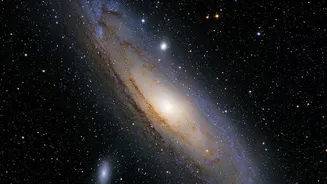
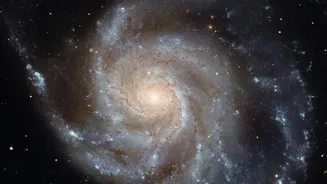
Imagine our sprawling, flat galaxy of stars being knocked on its side. That’s the stunning scenario proposed by astronomers who believe the Milky Way’s disc flipped by more than 90 degrees billions of years ago. This wasn't a sudden, jarring event. Instead,
it was a colossal and gradual reorientation that likely took at least a few hundred million years, and possibly as long as one or two billion years, to complete. The discovery, presented at the 2026 National Astronomy Meeting, adds a dramatic chapter to our galaxy's history, suggesting the calm cosmic neighbourhood we see today is the result of immense ancient chaos.
The Prime Suspect: A Cosmic Sausage
The culprit behind this cosmic upheaval is thought to be a dwarf galaxy known to astronomers as Gaia-Sausage-Enceladus, or the 'Gaia Sausage' for short. This name comes from the sausage-like shape formed by its stars' elongated orbits after the collision. Roughly 10 billion years ago, long before our solar system formed, this smaller galaxy slammed head-on into the young Milky Way. While our galaxy’s immense gravity tore the intruder apart and absorbed its stars, the impact was so powerful that it set in motion the gradual tilting of the entire Milky Way disc.
Reading the Galactic Scars
Scientists couldn't witness this flip directly, but they found clues in the stars. A key piece of evidence lies in the 'stellar halo,' a sparse, spherical cloud of ancient stars surrounding the main galactic disc. Data from the European Space Agency's Gaia mission revealed a long-standing mystery: while stars in the disc orbit the galactic centre at a brisk 220 kilometres per second, stars in the halo move incredibly slowly, at only about 10 to 25 kilometres per second. Researchers at Durham University used supercomputer simulations to investigate why. They found that Milky Way-like galaxies which experienced both a head-on collision like the Gaia Sausage merger and a subsequent disc flip ended up with the same kind of slow-moving halo we observe today. The slow rotation is a lingering scar from that ancient, violent reorientation.
What a Galactic Flip Looks Like
The term 'collision' can be misleading. Galaxies are mostly empty space, so when they merge, stars rarely smash into each other. Instead, the damage is done by gravity. As the Gaia Sausage galaxy passed through, its gravitational pull disrupted the Milky Way’s equilibrium, causing the entire disc of stars and gas to gradually shift its axis of rotation—like a spinning top slowly tilting over after being bumped. This means that for hundreds of millions of years, the plane of our galaxy was in flux. Even our own Sun, which formed much later, may have once moved on a very different trajectory than it does today.
A New Understanding of Our Home
This discovery reshapes our understanding of how galaxies like ours evolve. It shows that they are not static systems but are constantly changing through violent mergers that can have dramatic, long-lasting consequences. Identifying this past flip provides a new lens through which to interpret the structure of the Milky Way, from the movement of its stars to the orientation of its invisible dark matter halo. It paints a picture of a galaxy that is far more dynamic than we ever imagined, with a history written in the slow, silent dance of its stars. The evidence suggests our galactic home has been shaped by forces of unimaginable scale, a process that continues even today as the Milky Way slowly absorbs other, smaller satellite galaxies.