







A Cosmic Powerhouse in Our Backyard
Deep in the constellation Scutum, about 12,000 light-years from Earth, lies a fascinating celestial object that was first cataloged in 1983 but is only now revealing its true nature. Known as IRAS 18293-0941, this system consists of a stellar-mass black
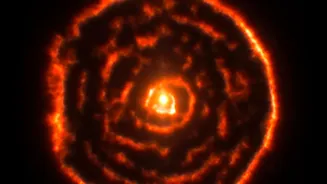
hole, roughly ten times the mass of our Sun, locked in a cosmic dance with a massive companion star. The two bodies orbit each other every 11 days. During this dance, the black hole’s immense gravity strips material away from its stellar partner. This stolen gas and dust forms a searingly hot structure called an accretion disk as it spirals toward the black hole, creating one of the most extreme environments in our galaxy. Though the object itself has been known for decades, its significance was hidden behind a thick veil of interstellar dust, making it invisible to most telescopes.
What Makes a Microblazar?
To understand the excitement around IRAS 18293-0941, it helps to first understand its larger cousin: the blazar. A blazar is an active galaxy with a supermassive black hole at its center, millions or billions of times the Sun's mass, that shoots a powerful jet of particles and radiation directly toward Earth. A microblazar is essentially a miniature, stellar-mass version of this phenomenon. It involves a smaller, stellar-mass black hole in a binary system that produces similar jets. What makes an object a microblazar specifically is the orientation of one of those jets. When it's aimed almost directly at us, an effect called relativistic beaming makes it appear exceptionally bright. This alignment gives astronomers a unique, face-on view of the physics happening right at the jet's base.
The Case for a Candidate
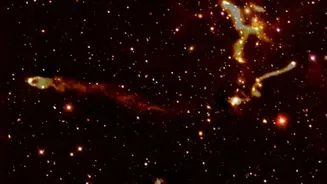
After decades of searching for a microblazar in our galaxy, astronomers now have a compelling candidate in IRAS 18293-0941. An international team of researchers used a combination of radio telescopes and other observatories to pierce through the dust obscuring the system. They detected a bright, one-sided radio emission, which is a classic sign of a relativistic jet pointing toward the observer. Models suggest the material in this jet is traveling at about 75% of the speed of light. While some expected features, like rapid flickering in brightness, haven't been observed yet, scientists believe this might be due to a dense cloud of gas around the system that smooths out the light. The evidence strongly suggests this is the microblazar scientists have long theorized should exist in the Milky Way.
A Laboratory for Extreme Physics
The discovery of a microblazar candidate in our own galaxy is more than just a novelty; it provides an invaluable natural laboratory. Distant blazars are billions of light-years away, making it impossible to study their jets in detail. Having a local analogue like IRAS 18293-0941 allows for a much closer look at how these cosmic engines work. The jet from this system is seen slamming into a dense cloud of interstellar gas about 100 light-years away. This collision accelerates particles to energies 100 times greater than what can be achieved at the Large Hadron Collider on Earth. Studying this interaction could help solve long-standing mysteries about the origin of the most energetic cosmic rays in our galaxy.