


Delicate, crisp, and elegantly curved, the French almond tuile is a masterpiece of texture and flavour. But have you ever wondered why sliced almonds are so crucial? It turns out they are far more than just a simple garnish.
An Icon of French Patisseries
A tuile is a classic French
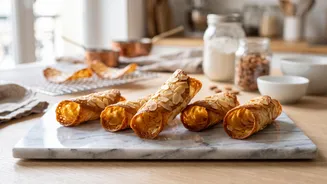
wafer cookie, named after the curved roof tiles seen in Provence that they resemble. Traditionally, these thin cookies are made from a simple batter of egg whites, sugar, butter, and flour. Immediately after baking, while still hot and pliable, they are draped over a rolling pin or a similar curved object to achieve their signature shape. While delicious on their own, they are often used in high-end restaurants as a garnish to add a crisp textural element to desserts like ice cream, mousse, or panna cotta.
The Architectural Role of the Almond Slice
In an almond tuile, the sliced almond is not just an addition; it is a foundational component. The key is their shape and thinness. When mixed into the thin batter, the flat, wide surface of each almond slice acts as a sort of scaffolding. They help control the spread of the cookie on the baking sheet, ensuring it bakes into a delicate, wafer-thin disc rather than an amorphous puddle. This uniform thinness is essential for the cookie's characteristic snap. The almonds integrate seamlessly into the batter, creating a cohesive structure that is both light and strong.
Unlocking Flavour and Texture
Beyond structure, sliced almonds are the primary source of the cookie's beloved nutty flavour. As the tuile bakes, the almonds toast and caramelise along with the sugars in the batter, releasing a rich, complex aroma and taste that butter and vanilla alone cannot replicate. This process also enhances the texture. The almonds provide a satisfying, glassy crunch that contrasts beautifully with the cookie's melt-in-your-mouth quality. This textural interplay is what makes eating a well-made tuile such a delightful sensory experience.
The Science of the Snap
The perfect tuile has a definitive 'snap'. This crispiness is achieved by baking out as much moisture as possible. Sliced almonds play a vital role here. Their low moisture content and the way they lay flat allows for even heat distribution and rapid caramelisation. This helps the surrounding batter to dry out and crystallise properly as it cools. Without the almonds interrupting the sugar and flour matrix, the cookie could end up chewy or soggy instead of shatteringly crisp.
Can You Substitute the Sliced Almonds?
While experimentation is the heart of baking, changing the form of the almond in a tuile recipe will fundamentally alter the result. Using almond flour, for instance, will create a denser, softer, more cake-like cookie because the flour absorbs moisture differently and doesn't provide structural integrity. Whole or roughly chopped almonds are too thick; they would create a lumpy, uneven texture and prevent the cookie from becoming wafer-thin. While you could use other similarly sliced nuts like hazelnuts for a different flavour profile, the classic texture is intrinsically linked to the specific geometry of a sliced almond. Flaked almonds are a suitable alternative, as they share a similar thinness.
Achieving the Perfect Tuile
For bakers looking to perfect their tuiles, the key is spreading the batter as thinly as possible. Some recipes even call for a stencil to ensure each cookie is uniformly thin. An even distribution of sliced almonds is just as important. Don’t overload the batter, as this can prevent it from spreading correctly. Be prepared to work quickly once the cookies come out of the oven; you only have a brief window when they are pliable enough to be shaped before they cool and harden. If they become too brittle, you can return them to the oven for a moment to soften them again.