



A World Reimagined
For decades, Pluto was little more than a fuzzy dot in our most powerful telescopes. We imagined it as a cold, geologically dead world. That all changed in July 2015 when NASA's New Horizons spacecraft flew past the dwarf planet, revealing towering mountains
of water ice, vast plains, and a surprisingly complex atmosphere. The mission completely rewrote our understanding of Pluto, transforming it from a distant outpost into a vibrant and active celestial body. The data sent back across nearly six billion kilometres continues to be a treasure trove for scientists, with new discoveries emerging even now, years after the historic encounter.
The Beating Nitrogen Heart
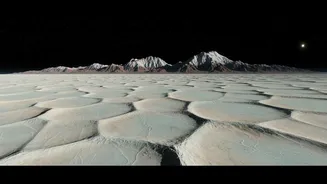
At the centre of Pluto's transformation is a massive, heart-shaped feature named Tombaugh Regio. The western lobe of this 'heart' is Sputnik Planitia, a colossal basin filled with frozen nitrogen ice that is more than a million square kilometres in size. One of the most stunning findings from New Horizons was that this plain is not static. Its surface is divided into city-sized polygonal cells, which are evidence of slow convection, like a planetary-scale lava lamp. This churning motion means the surface is constantly being renewed, which is why there are no impact craters—the surface is estimated to be less than 10 million years old, a mere blink of an eye in cosmic terms.
Signs of Flowing Liquid
Now, a re-analysis of high-resolution images from New Horizons has uncovered something even more remarkable. A study published in The Planetary Science Journal highlights dark patterns and streaks along the boundaries of the convection cells in northern Sputnik Planitia. According to the research team, led by New Horizons' principal investigator Alan Stern, these features strongly resemble areas on Earth that have been wetted by liquid. Since Pluto's thin atmosphere makes nitrogen rain impossible, the scientists hypothesise that liquid nitrogen may be welling up from beneath the massive glacier.
From the Bottom Up
The theory is that the immense pressure at the base of the kilometres-deep nitrogen glacier could be enough to melt the ice, creating pockets of liquid nitrogen. Computer simulations support the idea that this liquid could then travel up through cracks or conduits in the ice sheet, briefly flowing across the surface before re-freezing. “Pluto never stops surprising us,” Stern said, noting that the finding suggests a new kind of time-variable feature on the distant world. This isn't evidence of vast, flowing rivers, but rather a more subtle process of slushy, transient oozing that wets the surface, creating the dark patches seen in the images.
A Geologically Active World
The implications of this discovery are profound. For a small, distant body like Pluto, which was expected to have lost its internal heat billions of years ago, the presence of active liquid flows is a major puzzle. It suggests that Pluto may retain more internal heat than previously calculated, perhaps from the slow decay of radioactive elements in its core. This activity challenges the very definition of a 'dead' world. The evidence for liquid nitrogen, even if sporadic, cements Pluto's status as one of the most geologically fascinating and dynamic bodies in our solar system, fundamentally changing our perspective on how icy worlds can evolve and operate so far from the Sun.