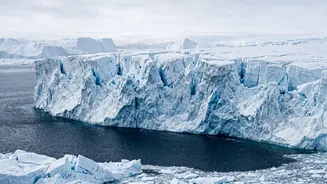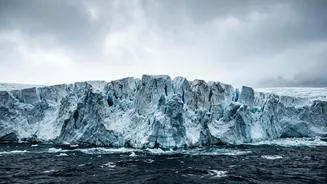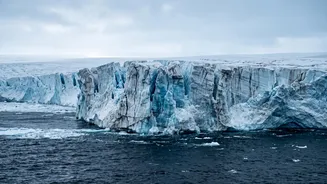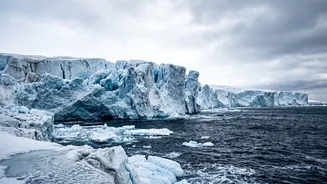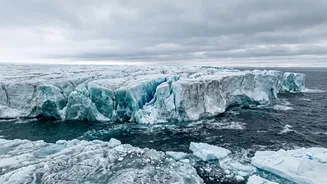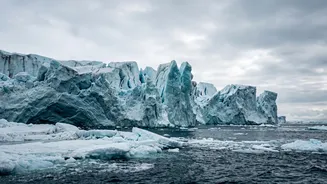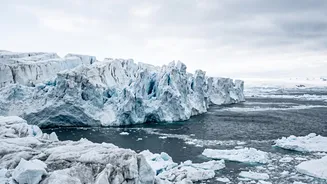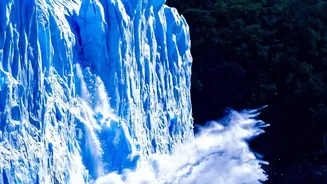



It’s nicknamed the 'Doomsday Glacier' for a reason. But new research on Antarctica's Thwaites Glacier suggests the future isn't just dire—it's more uncertain than ever, forcing us to rethink what the coming decades could mean for our coastlines.
The Glacier That Worries Scientists
Deep in
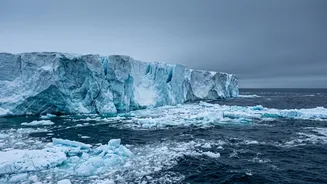
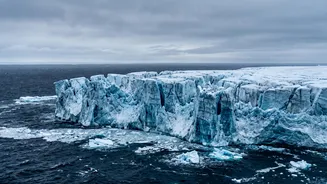
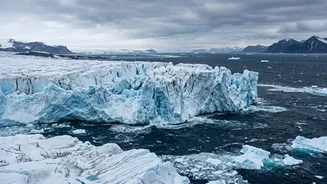
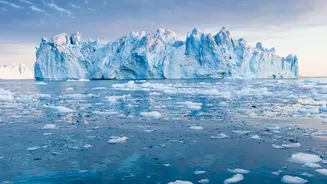
West Antarctica lies a river of ice so vast it's roughly the size of Florida or Great Britain. This is the Thwaites Glacier, and it has become one of the most intensely studied places on Earth. Its ominous nickname, the 'Doomsday Glacier', comes from the catastrophic potential of its collapse. Currently, its meltwater is responsible for about 4% of global sea-level rise, but that's only part of the story. Thwaites acts like a giant cork, holding back the rest of the colossal West Antarctic Ice Sheet. If it were to collapse entirely, it holds enough ice to raise global sea levels by over two feet on its own. More alarmingly, its failure could destabilise the entire ice sheet, potentially leading to a devastating 10 feet of sea-level rise over the long term.
A Shift From a Line to a Zone
For years, scientists have been trying to predict how quickly Thwaites will retreat. Old models treated the glacier's 'grounding line'—the point where the ice leaves solid ground and begins to float—as a relatively neat and stable boundary. However, recent research from NASA and the University of California, Irvine, has upended this idea. The new models incorporate a critical, newly understood process. Instead of a simple line, there is a 'grounding zone', a much wider area stretching for kilometres where warm ocean water intrudes deep beneath the grounded ice. This tidal pumping action allows warm, salty ocean water to attack the glacier's underbelly far more aggressively than previously thought, dramatically accelerating melting and instability.
Doubling Down on Uncertainty
This new understanding has profound implications. When researchers ran simulations with this more realistic 'grounding zone' physics, the results were startling. The models, published in the journal Nature Communications, now project that Thwaites' contribution to sea-level rise by the end of the century could be double what previous estimates suggested. In some scenarios, this happens even without any additional global warming beyond current conditions. The headline 'greater uncertainty' doesn't mean scientists are less sure; it means the range of potential outcomes is wider and leaning towards more severe scenarios. The models better match the glacier's observed retreat since the 1990s, giving scientists more confidence in these worrying new projections.
Losing Its Grip
The danger isn't just about melting. The glacier is held in place by underwater ridges, or pinning points, that act as anchors. The intensified melting at the grounding zone is weakening the glacier's grip on a critical feature known as the Mouginot Ridge. The new models predict a 60% probability that the glacier will become detached from this vital anchor by the year 2100. Once it is unpinned, the glacier's retreat is expected to speed up significantly as it slides down the sloping seafloor toward its next stabilising point, unleashing even more ice into the ocean. It is a tipping point that could lock in irreversible ice loss for centuries to come.
What This Means for India’s Coasts
An event happening thousands of kilometres away in Antarctica has direct consequences for India. A significant portion of India's population and economic hubs, including megacities like Mumbai, Chennai, and Kolkata, are located in low-lying coastal areas. An accelerated rise in sea levels magnifies every coastal threat, from routine high-tide flooding to the devastating impact of storm surges during cyclones. While a full collapse is not imminent in the next few years, these new models show that the problem may be advancing faster than planned for. The 'greater uncertainty' from Thwaites means that timelines for building resilient infrastructure, protecting coastal communities, and managing freshwater resources have become more urgent. The fate of this single glacier is a critical variable in the future security of India's long and vulnerable coastline.