






The Unsolved Mystery of Natal Homing
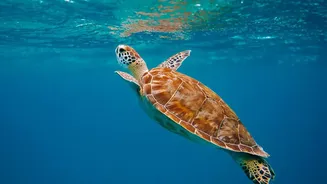
Imagine spending 15 to 20 years roaming the vast, open ocean, only to be guided back to a specific stretch of sand where your life began. This is the reality for female Olive Ridley turtles. This incredible feat is known as natal homing, and it has long
been one of the most profound mysteries of the natural world. These turtles travel across entire ocean basins, facing countless dangers, driven by an ancient instinct to return. In India, this culminates in the 'arribada', or mass nesting, a phenomenon most famously seen on the coasts of Odisha at sites like Gahirmatha and Rushikulya, which host the world's largest nesting populations.
An Internal Magnetic Map
The leading theory behind this remarkable ability is called geomagnetic imprinting. Scientists believe that when a hatchling makes its first frantic crawl from its sandy nest to the sea, it's doing more than just starting its life — it's recording an address. Every point on Earth has a unique magnetic signature based on its position, with subtle variations in the planet's magnetic field. The hatchling turtle essentially imprints on this specific magnetic fingerprint. This 'magnetic memory' is stored for years, creating an internal map that the adult turtle can later use to navigate its way back across the ocean.
How the Compass Works
Recent studies have added weight to this long-held hypothesis. Research on sea turtles, including loggerheads, has shown that they can detect not just the direction of magnetic fields (like a compass) but also their intensity and inclination angle. This combination of sensory inputs essentially provides them with a set of magnetic coordinates, allowing them to determine their geographical position in the vast emptiness of the ocean. Experiments have demonstrated that hatchlings will orient themselves differently when exposed to magnetic fields simulating different locations, proving they use this sense to stay on course during their massive migrations.
More Than Just Magnetism
While the magnetic map is crucial for the long-haul journey, it's likely not the only tool the turtles use. As they get closer to the coastline, other senses are believed to take over to fine-tune their approach. The chemical signature of the water, created by rivers, minerals, and local biology, may provide a unique scent for them to follow. The slope of the beach, wave patterns, and ocean currents also serve as local cues, guiding the turtle to a suitable nesting spot. It is this combination of long-range magnetic navigation and short-range environmental sensing that makes their journey so precise.
Why This Matters for Conservation
Understanding this complex navigation system is not just an academic exercise; it's vital for the conservation of this vulnerable species. Olive Ridleys face immense threats, from accidental capture in fishing nets—a major cause of mortality along the Odisha coast—to plastic pollution and coastal development. If their homing ability is tied to delicate magnetic and environmental cues, any disruption could be catastrophic. Coastal construction, shipping traffic, and even sources of strong radiofrequency waves could potentially interfere with their ability to find their way home. Protecting their nesting beaches is not just about saving a piece of sand; it’s about preserving the final destination of one of nature’s most epic and mysterious journeys.