


For decades, nuclear energy has been a source of both immense promise and heated debate. As nations grapple with climate change and rising energy demands, the International Atomic Energy Agency (IAEA) provides crucial data on its future role.
A Snapshot of 2025
By the end
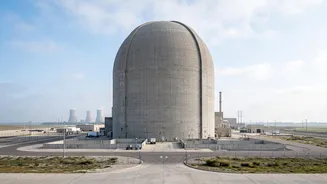
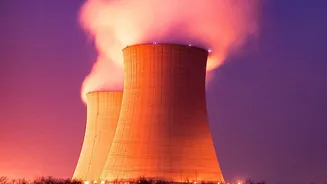
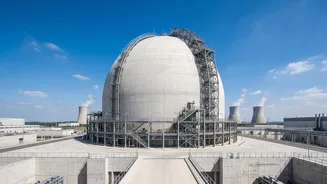
of 2025, nuclear power was a significant, if not dominant, player in the global energy landscape. According to reports from the IAEA and World Nuclear Association, nuclear reactors generated a record 2701 terawatt-hours (TWh) of electricity, supplying about 9% of the world's total electricity. This marked a notable increase from the previous year, highlighting a period of renewed growth and strengthening policy support for nuclear energy. In 2025, there were 413 operational reactors worldwide. While nuclear generation grew, its overall share of global electricity slightly decreased from 8.7% in 2024 to 8.4% in 2025, simply because total global electricity demand grew at an even faster pace. Still, it accounted for about a quarter of the world's low-carbon electricity, underscoring its importance in the fight against climate change.
A Shift in Global Ambition
The year 2025 served as a launching point for a dramatic upward shift in nuclear ambitions. The conversation gained significant momentum following the COP28 climate conference, where dozens of countries pledged to triple global nuclear capacity by 2050. This renewed enthusiasm is reflected in the IAEA's own projections. For six years in a row as of September 2026, the agency has revised its forecasts upwards. The latest high-case scenario projects that global nuclear capacity could more than triple by 2060, reaching approximately 1284 gigawatts (GWe) compared to 377.1 GWe at the end of 2025. This surge in optimism is driven by the urgent need for reliable, carbon-free power, a demand supercharged by the rise of artificial intelligence, data centres, and the broader electrification of transport and industry.
The Rise of New Technologies
A key factor in these ambitious future scenarios is the development and deployment of new reactor technologies, particularly Small Modular Reactors (SMRs). Unlike traditional large-scale reactors, SMRs are designed to be factory-built and transported to a site for installation, potentially reducing construction time and costs. The IAEA projects that SMRs could account for a significant portion of new capacity, representing up to 28% of all new additions by 2060 in its high-growth scenario. This marks a substantial increase in confidence for the technology. China and Russia already have operational SMRs, with several other countries including Canada, the United Kingdom, and the United States expected to begin construction soon. These advanced reactors are seen as a flexible solution for powering remote communities and decarbonizing industrial processes that are difficult to electrify.
India's Own Nuclear Journey
For India, these global trends are highly relevant. The nation is on its own aggressive expansion path for nuclear energy, viewing it as essential for meeting future power demands and climate goals. As of 2026, India has about 8.7 GW of installed nuclear capacity, contributing roughly 3% of the country's electricity. However, the government's ambitions are vast. Under its Nuclear Energy Mission, India aims to increase its capacity to 22.48 GW by 2031-32 and has set a long-term goal of reaching 100 GW by 2047. To achieve this, ten new reactors are already under construction, with more in the planning stages. This expansion relies on a mix of indigenous 700 MW reactors and larger units developed through international cooperation, reflecting a strategy to enhance energy security while reducing carbon emissions.