






A 'Once-in-a-Century' Discovery
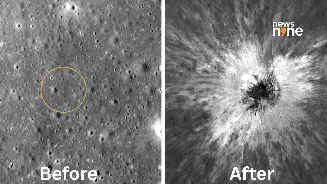
Scientists have officially named a massive new feature on the Moon: McGetchin crater. Discovered by NASA's Lunar Reconnaissance Orbiter (LRO), this is no ordinary crater. Measuring 222 meters (about 728 feet) across, it's roughly the length of two football
fields. An impact of this magnitude is estimated to happen only about once every 130 years, making this a rare and valuable finding. The impact itself occurred sometime between April and May 2024, but the crater was only recently identified by scientists combing through the vast amounts of data sent back by the LRO. The orbiter's ability to compare images of the same area over time allowed researchers to spot the fresh, bright ejecta blanket—material blasted out from the impact—standing in stark contrast to the darker, older surface.
A Pristine Window into the Past
What makes McGetchin crater so scientifically important is its youth. The Moon has no atmosphere to protect it, so its surface is constantly bombarded by solar wind and micrometeorites. This perpetual process, known as 'space weathering', dramatically alters the lunar soil, or regolith, over millions of years. It darkens the material, changes its chemical composition, and creates tiny glass-welded particles called agglutinates. For decades, scientists have primarily studied this weathered, 'mature' soil from the Apollo missions. McGetchin crater, however, has violently excavated and exposed fresh material from beneath this weathered layer. It provides a clean look at lunar soil before it has been significantly altered by the harsh space environment, acting like a freshly opened time capsule.
Challenging Old Assumptions
Studying 'old' soil has its limits. Imagine trying to understand Earth's geology by only looking at soil that's been exposed to wind and rain for millennia. The original properties would be obscured. The same is true for the Moon. Space weathering makes it difficult to determine the true composition of the lunar crust and mantle. All of our existing samples, brought back by the Apollo and Luna missions, have been subjected to this weathering. Scientists have had to develop complex models to try and see past the effects of maturation. The McGetchin crater provides a ground truth—a baseline of what 'unweathered' soil actually looks and behaves like. This allows researchers to calibrate their instruments and refine their understanding of the entire space weathering process.
More Than Just a Hole
The impact that created McGetchin didn't just dig a hole; it fundamentally changed the surrounding landscape in surprising ways. Data from the LRO's thermal instrument revealed a 7-kilometer-wide (over 4 miles) 'cold spot' around the crater. At night, this area is significantly cooler than the terrain around it. Scientists believe the impact's shockwave 'fluffed up' the regolith, making it less dense. This less dense, more porous soil is a poorer conductor of heat, causing it to cool down much faster during the long lunar night. This finding is crucial because it shows that impacts can alter the physical properties of the lunar surface far beyond the crater's rim, which has direct implications for future lunar missions.
Implications for Future Exploration
Understanding the true nature of lunar soil is not just an academic exercise. As nations like India, the US, and China plan for a sustained human presence on the Moon, knowing how to work with the local resources is critical. Lunar regolith is a candidate for 3D-printing habitats and radiation shielding. The discovery of how a fresh impact changes the soil's density and thermal properties is vital information for engineers designing rovers, landing pads, and habitats. The fluffier soil might behave differently under the wheels of a rover or the foundation of a building. Furthermore, studying how quickly the surface is churned by impacts helps scientists better estimate the age of lunar landscapes and the hazards future lunar explorers might face from debris.