



A Breakthrough from the Ground Up
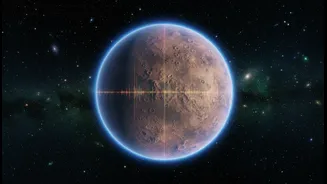
For the first time, astronomers have detected the signature of an atmosphere on a rocky, habitable-zone exoplanet using a ground-based telescope. An international team of researchers used the innovative WINERED spectrograph, attached to the Magellan Clay
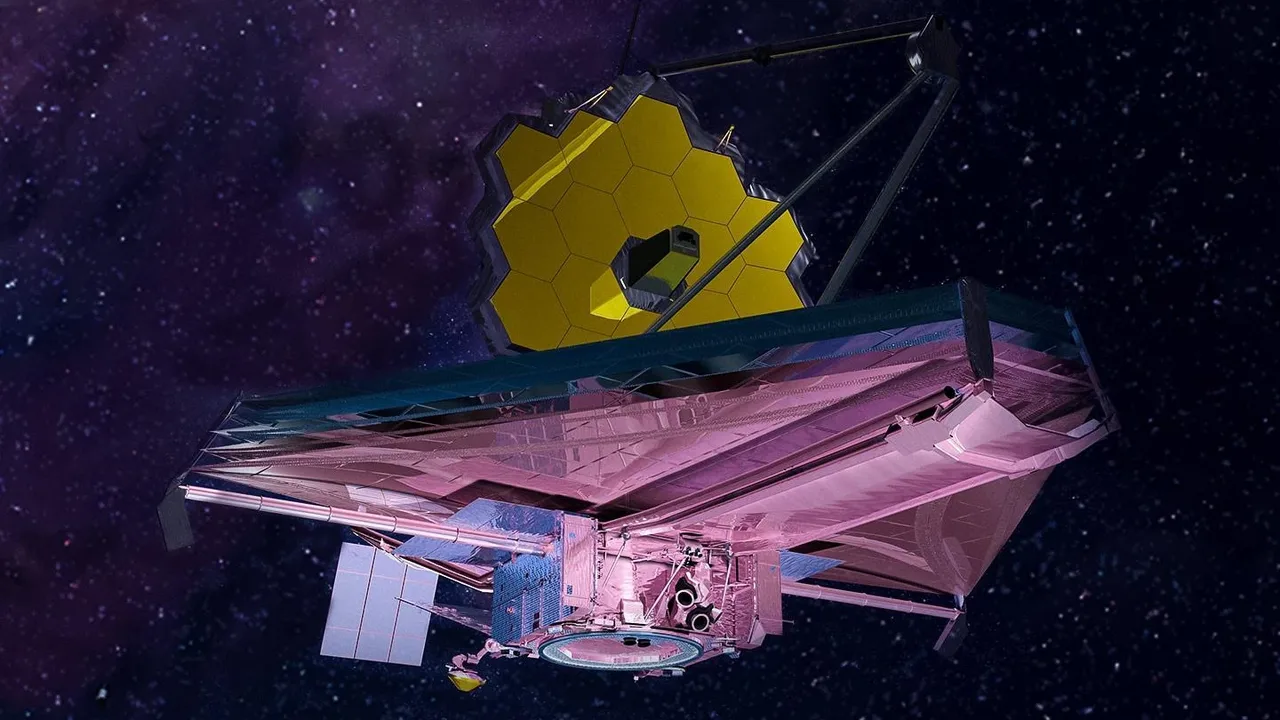
telescope in Chile, to find evidence of helium escaping the atmosphere of a 'super-Earth' named LHS 1140 b, located about 48 light-years from us. This achievement marks a pivotal moment in astronomy. While space telescopes like the James Webb Space Telescope (JWST) are powerful, they are also in high demand. Proving that this kind of sensitive work can be done from Earth opens the door to studying many more potentially habitable worlds, more frequently and at a lower cost. It’s a game-changer for how we will search for life-sustaining conditions across the galaxy.
The Power of the WINERED Spectrograph
The hero of this story is the WINERED spectrograph. Developed by a team at Kyoto Sangyo University, its name stands for Warm INfrared Echelle spectrograph to Realize Extreme Dispersion and sensitivity. In simple terms, a spectrograph is an instrument that takes light from a distant object and splits it into its component colours, or spectrum, like a prism. Within this spectrum, astronomers can see dark or bright lines, which act as chemical fingerprints, revealing which elements and molecules are present. WINERED is special because it operates in the near-infrared part of the spectrum with incredibly high resolution and sensitivity, without the need for extreme cryogenic cooling that many infrared instruments require. This allows it to pick up faint signals, like those from an exoplanet's thin atmosphere as it passes in front of its star. These capabilities were crucial for making this recent detection possible.
Targeting a Promising Super-Earth
The target of the observation, LHS 1140 b, is a fascinating world in its own right. Discovered in 2017, it is classified as a 'super-Earth,' with a mass around 5.6 times that of our planet. It orbits its star within the 'habitable zone'—the orbital distance where conditions could be just right for liquid water to exist on the surface. This makes it a prime candidate in the search for life. Previous observations have been challenging, and confirming the presence of an atmosphere on rocky planets like this has been a major technological hurdle. The team focused their search on helium because its signal can be easier to detect in a planet's upper atmosphere. The detection not only confirms the planet has an atmosphere but also suggests it is substantial enough to have survived for billions of years.
A Layered Atmosphere and Hints of Water
The discovery does more than just confirm an atmosphere exists; it provides clues about its structure. The team's models, combined with the WINERED data, suggest a layered atmosphere. They predict an upper layer dominated by helium, which is what they observed escaping, while heavier elements like water are likely trapped at lower altitudes, closer to the planet's surface. This finding aligns with observations of other exoplanets, such as GJ 1214 b, where studies have also pointed towards water-rich atmospheres. The ability to detect one component (helium) from the ground strongly implies that future observations, perhaps by JWST, will be able to probe deeper and search for these trapped water molecules, which are essential for habitability.
Why This Ground-Based First Matters
Detecting atmospheres on rocky exoplanets has historically been the domain of expensive, over-booked space telescopes. This achievement demonstrates that ground-based facilities, when equipped with advanced instruments like WINERED, can play a critical role. Earth-based telescopes can be built, upgraded, and accessed more easily, allowing for widespread and repeated observations. This will dramatically increase the number of planets whose atmospheres can be studied. By using ground-based surveys to identify the most promising candidates with confirmed atmospheres, astronomers can then use precious time on space telescopes like JWST more efficiently, targeting the worlds most likely to harbor water or even biosignatures. This new capability accelerates the entire process of characterising distant worlds and brings us a significant step closer to answering the ultimate question: are we alone?