


A Portrait of a Dying Star
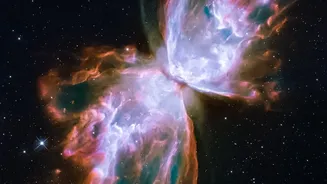
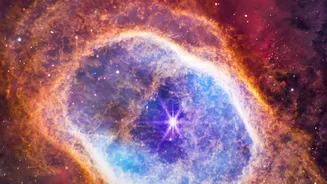
The subject of Webb's new image is NGC 2392, a stunning celestial object known as a planetary nebula. The name is a historical misnomer from early astronomy; these have nothing to do with planets. Instead, a planetary nebula is the glowing, expanding
shell of gas shed by a star in the final stages of its life. For thousands of years, the star at the center of NGC 2392 has been puffing its outer layers into space, creating the intricate structure we see today. Due to its appearance in older, ground-based telescopes, it was nicknamed the Eskimo Nebula or Lion Nebula. These latest observations focus on the complex, lion-like mane of gas and dust sculpted by the dying star at its core.
What Webb's Infrared Eyes Reveal
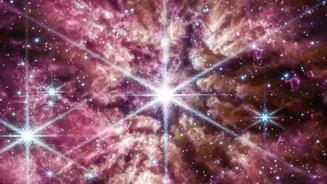
Previous telescopes like Hubble have imaged NGC 2392, but Webb's powerful infrared instruments, NIRCam and MIRI, cut through the cosmic haze to reveal hidden details. The new data maps the presence and structure of dust and gas with remarkable clarity. Webb's view distinguishes between different components: a bubble of ionized gas forms the central 'face,' while cooler, dusty filaments make up the sprawling outer 'mane'. Some of this dust is being destroyed by intense radiation from the hot stellar core, but other, denser clumps are managing to survive. These resilient dust clumps act like shields, protecting material behind them and creating the wispy, comet-like tails that stream away from the star.
The Science of Drifting Layers
The headline's "drifting outward" points to a key part of how Sun-like stars die. It’s not a single, violent supernova explosion—that fate is reserved for much more massive stars. Instead, stars like the one that created NGC 2392 die a slower, more graceful death. Over millennia, they expel their outer layers through powerful stellar winds. Observations reveal a complex interaction: an earlier, slower wind was followed by a much faster wind from the exposed, hot core of the star. This interaction between fast and slow winds, combined with radiation from the central star, sculpts the gas and dust into the shells and filaments Webb has now mapped. This process isn't static; the gas and dust will continue to expand and drift away, and astronomers estimate the nebula will completely disperse in about 10,000 years.
A Glimpse of Our Solar System's Future
Studying NGC 2392 isn't just an academic exercise in a distant object; it's like looking at a preview of our own Sun's destiny. In about five billion years, our Sun will exhaust the hydrogen fuel in its core, swell into a red giant, and eventually cast off its outer layers to form its own planetary nebula. The Earth will be long gone, but the process will be remarkably similar to what we see in NGC 2392. These observations help scientists refine their models of stellar evolution, answering fundamental questions about how stars live and die. By mapping the materials being returned to the cosmos, Webb helps us understand the cosmic recycling process, where the remnants of dead stars provide the raw materials for the next generation of stars and planets.