





Our New Eye on the Solar Frontier
Launched in late 2025, NASA's IMAP spacecraft is a modern-day celestial cartographer. Its job isn't to visit the edge of the solar system, but to smartly observe it from about 1.5 million kilometers away, at a stable point between the Earth and the Sun.
From this vantage point, it intercepts cosmic messengers—particles that have traveled billions of kilometers from the chaotic frontier where our sun’s influence ends and interstellar space begins. After beginning its primary science mission in February 2026, the probe's ten sophisticated instruments have been busy collecting information. Now, data from seven of those instruments is publicly available, marking a major milestone.
Decoding the Heliosphere
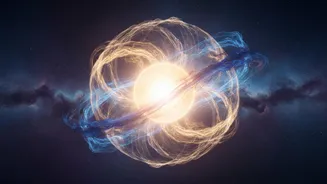
Our solar system exists inside a massive bubble called the heliosphere, inflated by a constant stream of particles flowing from the sun called the solar wind. This bubble acts as a vital shield, deflecting much of the harsh cosmic radiation from the wider galaxy and creating a more habitable environment for Earth. For decades, scientists have theorized about this boundary, known as the heliopause. The only direct measurements came from the Voyager 1 and 2 probes, which crossed this frontier in 2012 and 2018, respectively, after decades of travel. But two single points of data are not enough to understand the whole structure. IMAP is designed to create a complete, 3D map of this entire boundary.
What the First Data Reveals
The first public data release from IMAP is already painting a richer picture. Instruments like the Solar Wind and Pickup Ions (SWAPI) and the Solar Wind Electron (SWE) are providing unprecedented details about the particles flowing from the sun and those originating from interstellar space. The data helps scientists track how the solar wind pushes back against the interstellar medium—the sparse mix of gas and dust between stars. One of IMAP's key techniques is measuring Energetic Neutral Atoms (ENAs). These are special particles created when the outbound solar wind collides with inbound interstellar material. Since they are neutral, they travel in straight lines back toward the inner solar system, carrying a direct snapshot of their origin point at the boundary. The initial data is already being used to build the first all-sky map of these atoms, offering an early glimpse into the shape and dynamics of our cosmic shield.
A Sharper Look at Space Weather
Beyond mapping the frontier, IMAP has a crucial secondary job: improving space weather forecasts. The same instruments that study the solar wind can detect solar storms and bursts of harmful radiation heading our way. The I-ALiRT (IMAP Active Link for Real-Time) system continuously streams this data to forecasters on Earth. This provides an enhanced warning system for satellites, power grids, and especially for astronauts on future missions to the Moon and Mars, giving them critical time to prepare for incoming solar particle events. The early data has already proven its value, with the SWE instrument successfully capturing the full impact of a solar flare that was so intense it forced other instruments into a temporary safe mode.
Why This Cosmic Boundary Matters
Understanding the heliosphere isn't just an academic exercise. This boundary is the first line of defense for our entire solar system. How it filters interstellar material, how its shape changes in response to the sun's activity, and how effectively it shields us from galactic cosmic rays are fundamental to understanding our place in the galaxy. Previous missions like the Interstellar Boundary Explorer (IBEX) provided the first maps, but IMAP's instruments are vastly more sensitive, promising to solve lingering mysteries, such as whether the heliosphere is shaped like a sphere, an egg, or something else entirely. This new data represents the first chapter in a story that will redefine our understanding of the solar system's interaction with the rest of the universe.