


Why Add Rotation to Your Plank?
The traditional side plank is an isometric exercise, meaning you hold a static position. This is excellent for building endurance in the core muscles, particularly the obliques (the muscles on the sides of your abdomen). However, adding a rotational component—often
called a "thread the needle" movement—introduces dynamic stability. Instead of just resisting gravity, your core must now control movement through space. This builds anti-rotation strength, which is crucial for protecting your spine during daily activities like carrying groceries, playing sports like golf or tennis, or simply twisting to grab something. This dynamic version engages a wider array of stabilising muscles, including the deep transverse abdominis, the quadratus lumborum in your lower back, and even the stabilisers in your shoulders. By moving, you challenge your balance and body awareness in a way a static hold cannot.
How to Perform the Rotational Side Plank
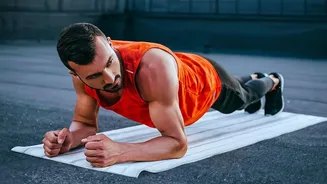
Proper form is everything. Rushing through repetitions with poor technique is less effective and risks injury. Follow these steps for a perfect rotational side plank: 1. Get into position: Start in a standard side plank. Place your forearm on the floor with your elbow stacked directly under your shoulder. Your body should form a straight, rigid line from your head to your feet. Your feet can be stacked on top of each other or, for more stability, placed one in front of the other. 2. Engage your core: Before you move, lift your hips high, preventing them from sagging. Tighten your abdominal muscles as if bracing for a punch. This sets a stable foundation. 3. Initiate the rotation: Extend your top arm straight toward the ceiling. In a slow, controlled motion, rotate your torso forward and reach your top arm through the space underneath your body. Exhale as you twist under. 4. Return with control: Inhale as you reverse the movement, unwinding your torso and reaching your arm back up to the starting position. The key is to control the movement in both directions, avoiding any jerky motions.
The Importance of a Neutral Spine
Maintaining a neutral spine is arguably the most critical aspect of this exercise. A neutral spine refers to the natural curves of your neck, upper back, and lower back. Deviating from this position by either excessively arching or rounding your back places unnecessary stress on your spinal discs and joints. During the rotational side plank, the goal is to rotate through your upper back (thoracic spine) while keeping your lower back and pelvis stable. If you allow your lower back to twist, you negate the core-stabilising purpose of the exercise and risk injury. Think of your core as a strong, locked cylinder from your ribcage to your pelvis; the rotation should happen above it. Keeping your head aligned with your spine—not dropping it or looking up—is also essential to prevent neck strain.
Mastering Hip Control
Just as crucial as spine neutrality is hip control. The most common mistake in any side plank variation is letting the hips sag toward the floor. This indicates that the core and glute muscles are not fully engaged, and it puts stress on the shoulder joint. During the rotational side plank, you must actively fight this tendency. Keep your hips lifted and stacked, one directly on top of the other. As you rotate your upper body, resist the urge to let your hips rock forward or backward. This is the “anti-rotation” element at work. If you find your hips moving excessively, slow down the movement and reduce your range of motion until you can perform the exercise with complete stability. A simple glute squeeze can help set your pelvis in the correct, stable position.
Modifications for Every Fitness Level
The rotational side plank is a scalable exercise. If you're a beginner or find the full version too challenging, start with a modification. The easiest way to reduce the difficulty is to perform the exercise from your knees instead of your feet. Set up with your bottom knee bent and on the floor, keeping a straight line from your head to that knee. This provides a wider, more stable base of support while still allowing you to practice the rotational movement. As you get stronger, you can progress to the full version. To make the exercise more challenging, you can hold a light dumbbell in your top hand or increase the time under tension by moving more slowly through each phase of the rotation.