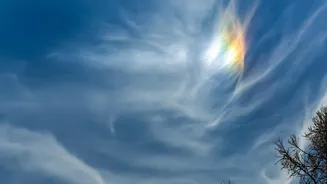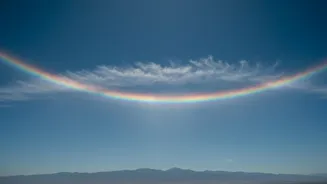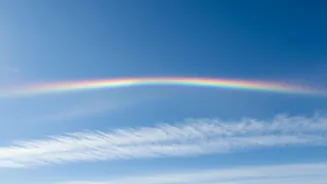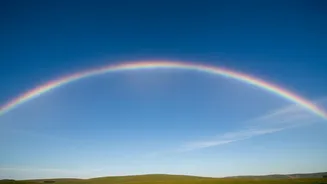






What Exactly Is a Fire Rainbow?
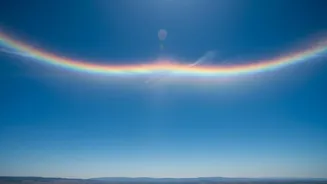
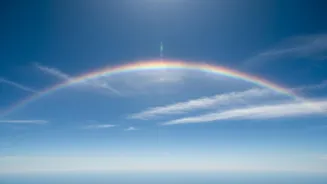
First, let's clear up the name. A “fire rainbow” has nothing to do with fire and isn't a rainbow in the traditional sense. Its scientific name is a circumhorizontal arc. Unlike a true rainbow, which is formed by the refraction and reflection of light
in water droplets and always appears opposite the sun, a circumhorizontal arc is a type of ice halo. These arcs appear as a colourful band running parallel to the horizon, often so large and vibrant they look like a piece of a rainbow has been laid flat against the sky. They are also located below the sun, not opposite it.
Checklist Item 1: A High Sun
The first and most critical ingredient for a fire rainbow is the sun's position. For this phenomenon to occur, the sun must be extremely high in the sky, specifically at an elevation of 58 degrees or more above the horizon. This is a strict requirement, which is why these arcs are impossible to see at latitudes above 55 degrees North or below 55 degrees South, where the sun never gets that high. In mid-latitude regions, like much of India, the best time to spot one is during the middle of a summer day when the sun is at its peak. The arc's intensity is actually greatest when the sun reaches an elevation of about 68 degrees.
Checklist Item 2: The Right Kind of Cloud
You can't have a circumhorizontal arc without clouds, but not just any cloud will do. The recipe calls for high-altitude cirrus clouds. These are the thin, wispy clouds you see very high up in the atmosphere, often looking like delicate filaments. They exist at altitudes where the temperature is extremely low, meaning they aren’t made of water droplets like lower-level clouds. Instead, they are composed entirely of tiny ice crystals. The presence of these specific clouds is non-negotiable for the light show to begin.
Checklist Item 3: Perfectly Aligned Ice Crystals
This is where the real magic of atmospheric optics comes into play. The ice crystals within the cirrus clouds must not only be present, but they must also have a specific shape and orientation. To form a circumhorizontal arc, the clouds need to be full of plate-shaped, hexagonal (six-sided) ice crystals. Crucially, these tiny, flat crystals must be oriented horizontally as they float through the air, like millions of microscopic plates lying flat. If the crystals are jumbled, oriented randomly, or are the wrong shape (like columns or needles), the effect won't happen. This precise alignment is one of the reasons the phenomenon is relatively rare.
Putting It All Together: The Light Path
With all the ingredients in place, the final step is the path of the light itself. Sunlight from the high sun enters the vertical side face of a flat, hexagonal ice crystal. It then refracts, or bends, as it passes through the ice and exits through the horizontal bottom face. This 90-degree bend acts like a prism, splitting the white sunlight into its component colours, with red appearing on top and violet on the bottom. When an entire cirrus cloud is filled with millions of these crystals all aligned the same way, they collectively refract the light toward the ground. To an observer in the right spot, this creates the stunning, wide band of pure colour that we call a fire rainbow.